
Steve Randy Waldman
@interfluidity.com
i intended a less cynical take than that...
i intended a less cynical take than that...
maybe in an AI world most of our jobs should be legislator.
the bombing will continue until peace is achieved.
fourteen years ago @allinwithchris.bsky.social wrote "Twilight of the Elites" about public disillusionment with Enron's fraud and the financial crisis, the churches giving cover to pedophilia, failed Middle East wars. 1/
we had a populist revolt… and elected people who are openly corrupt con-men, a President who was a good friend to, and perhaps co-connoisseur with, the organizer of an extraordinary pedophilia ring, people who are perpetrating new Middle East wars on paper thin pretexts. 2/
no wonder the public is nihilistic. empirical experience suggests the only choice they face is between the frying pan and the fire. /fin
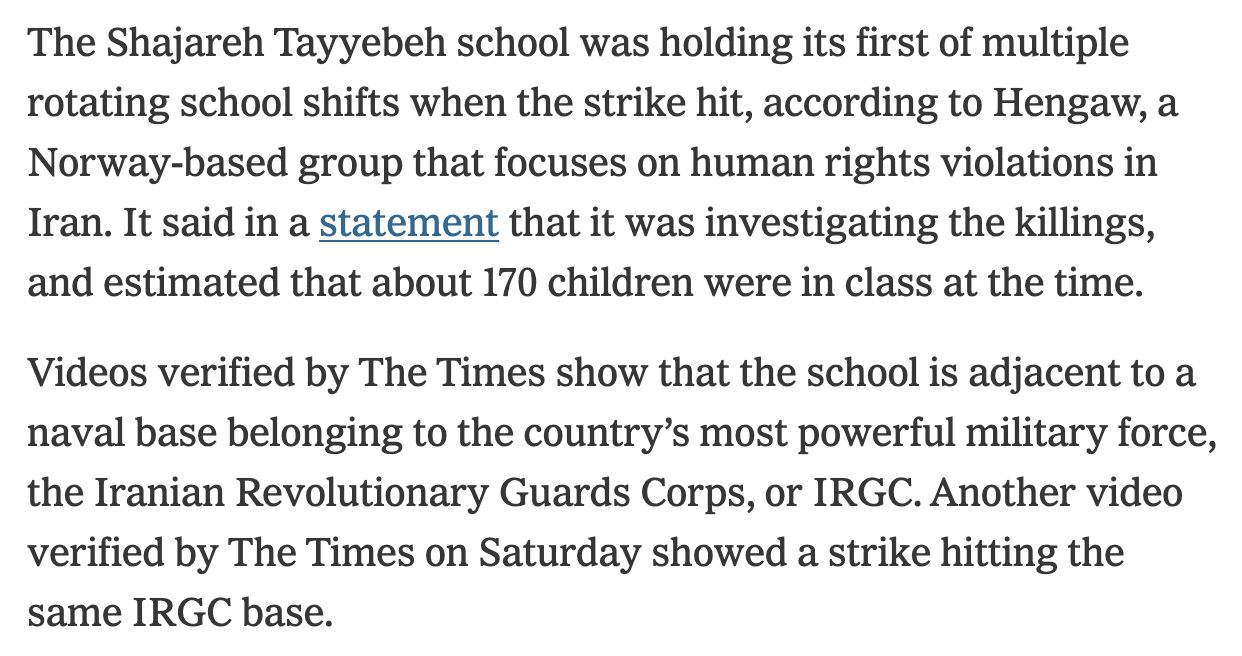 Text: The Shajareh Tayyebeh school was holding its first of multiple rotating school shifts when the strike hit, according to Hengaw, a Norway-based group that focuses on human rights violations in Iran. It said in a statement that it was investigating the killings, and estimated that about 170 children were in class at the time. Videos verified by The Times show that the school is adjacent to a naval base belonging to the country's most powerful military force, the Iranian Revolutionary Guards Corps, or IRGC. Another video verified by The Times on Saturday showed a strike hitting the same IRGC base.
apparently the way you win the peace is to begin the war with an atrocity. i never thought i could be made nostalgic for the relative competence of the GWB administration. www.nytimes.com/2026/02/28/w...

Iran Says Dozens Are Killed in Strike on School
Link Preview: Iran Says Dozens Are Killed in Strike on School
which regime might this war change? i can think of at least three candidates.
they are monitoring developments closely from the situation cabana.
“Trump has boldly told the regime to lay down its weapons and surrender—but to whom?”
Loading quoted Bluesky post...
i didn’t mean to. i removed the link text it automatically added when i pasted, but i guess i forgot to remove the link card bsky automatically adds.
i’ll redo.
it’s funny that Stanford is too woke for them.
the framing is a bit metaphorical and metaphysical, the entropy gradient is the “fire”, but it might not be wrong there’s a kind of tailwind from physics that makes it more likely we lock in bad outcomes. the automobile and locking in a very inefficient built environment might be a prior example.
yes! i don’t think Josh (the author) is in any sense “anti-AI”. 1/
i think the argument is that we want to develop intentionally, carefully, trade the entropy we generate for the best, safest, most “aligned” we can get, but the “e/acc” ethos is lock-in the first mover fast, and the first-mover is unlikely to be the best, or even good at all. 2/
so Anthropic/Dario, who he sees as genuinely trying to steer things well, is effectively stuck at the pace and kind of shittiness “e/acc” sets, because the e/accholes are running downhill, in entropy terms, and better actors can’t compete if they don’t match the pace. 3/
they are trapped, he says, and know they are. at least they know they are, which is better than pretending building dissipation machines as hard and fast as possible is definitionally progress. /fin
Yeah, he's not writing about "will the AI drop bombs?" 1/
Your interpretation of the 2nd Law is the standard one, I think. 2/
The essays are based on a less standard, but I don't think ridiculous, view that the tendency toward entropy in effect sometimes drives, rather than merely permits, local "syntropy" (order) in the form of dissipative structures that accelerate global entropy. 3/
The claim is not that nuking us all is the end state. From a teleological perspective, nuking us all would destroy a lot of dissipative structures, like humans and AI and our cars and inventions! 4/
It's that AI directly (by its energy costs) and indirectly (by its inventions and applications) is a dissipative structure, can be expected to accelerate the increase in entropy, so there is a kind of natural bias towards its development. But that should not be mistaken for a normative good. /fin
they need mass surveillance of americans to prove it's not just them, everybody does it.
the coolest conspiracy would be if one of the other companies betting their future on AI bribed the administration to kneecap current-leader Anthropic via its own sanctimony. (sanctimony which, by the way, i fully support!)
Gack! I've managed to quote the second essay in the series, but link the first one. Both are great! Here's the link to the second essay: syntropic.xyz/posts/2026-0... Thanks, and sorry, to the author for pointing out my error.
Loading quoted Bluesky post...
"Nature abhors a vacuum" is really just a colorful description of how gas diffuses with a side effect of imposing force where there is a pressure gradient, but you won't go too wrong imagining something more active. 1/
I'm not saying I fully endorse an analogous account of entropy, that the facts of physics amount to an "as if" of the teleological claim. But I'm not ready to fully dismiss it either. 2/
It does seem surprising from first principles how often surprising order emerges that do not contradict the 2nd law only because they accelerate some other disorder. 3/
Thinking of the 2nd law in purely statistical terms (the universe slips into ever less unlikely categories of states), you'd predict a kind of passive diffusion rather than emergence of these elaborate mechanisms that the 2nd law might tolerate but that seem extraordinarily unlikely. 4/
So a teleological intuition might be usefully descriptive. I'm not fully persuaded, but I'm not fully persuaded that not. In any case, that intuition is the premise of the essay. It might be wrong, but I think it demands more consideration than immediate dismissal. /fin
i’d say this conjecture about AI would make it the opposite of “God”.