
Steve Randy Waldman
@interfluidity.com
really depends upon our definition of us, though. unless we tariff or otherwise protect domestic production, US consumers pay the full global price. 1/
really depends upon our definition of us, though. unless we tariff or otherwise protect domestic production, US consumers pay the full global price. 1/
“we” are insulated in a macroeconomic sense — it’s good for the dollar! and those few significantly on the receiving side of oil revenues are made better off. but the vast majority of “us” suffer with the rest of the world. /fin
there was always that “if” predicate.
if we were serious, wouldn’t we revert to COVID-style collective hibernation to help neutralize the oil weapon? as scale of sacrifice during wartime goes, that seems well within bounds. maybe harder since no one bothered to persuade the public this war was a just cause or a good idea?
the choice is never neoliberalism or fascism. insufficiently managed and regulated economic liberalism yields social dysfunction then fascism as backlash and synthesis. they are complements, not substitutes.
it turns out that the antidote to the pathologies of the best and the brightest is not in fact the worst and the stupidest.
the story about the employer who had no clothes is not about the king nor about the kid but about everybody else.
Loading quoted Bluesky post...
* emperor! sheesh.
“war has a way of creating a dynamic you don't control by changing the incentives in ways that can make things you would never have considered possible at the beginning seem inevitable later.” ~Philippe Lemoine www.philippelemoine.com/p/a-few-thou...

A Few Thoughts on the Iran War
Link Preview: A Few Thoughts on the Iran War: We’re now almost one month into the war and I wanted to share a few thoughts on it.
nope! everything is tentative.
“There is a greater disparity among the richest 10 percent of Brazilians than among the remaining 90 percent of the population.” ~Rodrigo Toneto www.phenomenalworld.org/analysis/fis...
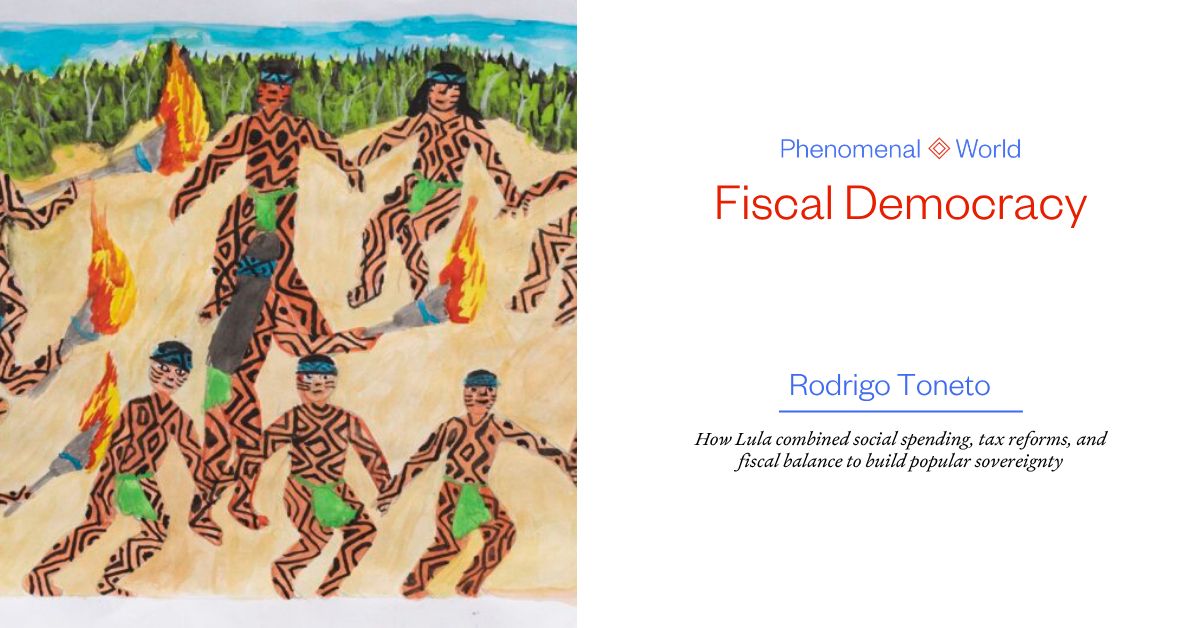
Fiscal Democracy | Phenomenal World
Link Preview: Fiscal Democracy | Phenomenal World: Lula’s overhaul of the tax system represents a challenge to the Brazilian oligarchy which goes beyond the distributive policies of previous PT governments.
from which lightning bursts!
somewhere in these ashes there is a phoenix.
Loading quoted Bluesky post...
i suspect it may be better than an intersecting one.
what if the strait just stays closed and the price encourages alternative supply?
Voters should ideally should literally know the people they are voting for. If they cannot, they should at least know what the party they are voting for is about and stands for. None of us have the opportunity to know that in the current system. None of us are informed in the current system.
why do you favor reading descriptive posts as endorsements?!?!?
I guess my view is that the place you want passionate intensity to really register is in the representative part of the legislature (the house in the US system). You do want passionate voices there, expressing differences in intensity of preference, negotiating across all those intensities. 1/
But for positions where one (or two) people have to represent the whole polity, letting the most passionate win is a prescription for subtly shafting the many. In the economics lingo, it's parallel to the "concentrated benefits, diffuse costs" problem. 2/
The passionately partisan mayor, or president, or whetever pursues his / his constituencies passions, while trying to avoid too upsetting the rest. The result is a world that seems "rigged", disadvantaging that rest, subtlely but even as in fact their interests are unfairly overlooked. 3/
Of course, the choices of a "squish" executive chosen because everyone can live with her should ultimately reflect intensity of preferences. Just not her own! 4/
If one group has very intense preferences for policy X, and another larger group has a mild dispreference for X but a strong preference for Y, which the other group values not at all, she might well push through a bargain. 5/
She might for X *and* Y, where fulfilling the passionate preference X of the smaller group is traded for everyone acceding to Y, which the larger group values. 6/
The point is, those with intensity of preferences (or a better ground game) or whatever should not automatically or by default "win" in a well-ordered system. 7/
Whether via a legislature or mediated via an executive, intensity of preferences should play a role in the negotiations that lead to outcomes everyone can live with. 8/
In contrast to your caucus enthusiasm, I favor Australian (and Uruguayan) style compulsory voting. A successful state needs input from everyone. A game that let's inertia or discouragement lead to disenfranchisement will not adequately serve a whole public. 9/
By all means, it's important that some constituencies value some things a lot, and some things only a little (such that polling "do you value this?" is not very meaningful). 10/
But intensity of preference should be an input in crafting a policy portfolio acceptable to (nearly) everyone, never a means of even de facto excluding certain constituencies or preferences from the negotiation. /fin
A couple of things. Many of the reforms are just bad. Top two primaries recapitulate the original sin of a democracy made of persons rather than parties. 1/
Ranked choice is less terrible, but not great. People either vote strategically when things are close, or don’t understand how to and are surprised by outcomes that then seem illegitimate. A great virtue of approval voting is its simplicity. 2/
But a hard fact is that a decentralized “laboratories of democracy” approach can’t address our catastrophe. A nationalized “two-party doom loop” (as @leedrutman.bsky.social puts it) is a matter of national politics. 2/
If local elections do something different, that can be interesting, but the prestige and coordination of the two major parties is going to significantly prevent the work of building an expressive multiparty electoral system even at the local level. /fin
But we really could elect Senators by approval voting. And that would lead, over time, in the same states, to very different people becoming Senators. And to a very different kind of political dialogue and campaign, as kneecapping the other guy becomes a less effective, more dangerous strategy.
(i’d not oppose it, but would argue reconfiguring states is an even harder lift than electoral reform. statehood for PR and DC seems doable at least.)