Steve Randy Waldman
@interfluidity.com
lina khan did the work, but biden never shouted it out. it was, like, uncouth for him to take pride in the very best work of his administration. so trump gets to claim all the credit.
Loading quoted Bluesky post...
Steve Randy Waldman
@interfluidity.com
there's a level of virtuosity in being corrupt in the way you prosecute your corruptions. and the very corruption of your corruption (in PA at least) was why you can't be prosecuted! it became fraud, not vote buying, and who's going to prosecute elon musk for fraud? it's like a pigeon for jaywalking
Steve Randy Waldman
@interfluidity.com
one of the many ironies of the moment is it's the people who style themselves defenders of western civilization that are the greatest threats to the achievements of western civilization.
Steve Randy Waldman
@interfluidity.com
Yes! That's pretty much precisely the point of the essay I linked just above. The only form of financial regulation that will ever be credible must be structural rather than supervisory. Regulators can never be so well tied to the mast they don't jump in to calm the seas. bsky.app/profile/inte...
Loading quoted Bluesky post...
Steve Randy Waldman
@interfluidity.com
if Elon Musk has more money than every human who ever existed combined, and the rest of us are eating bark, by the numbers America would have never been wealthier!
Loading quoted Bluesky post...
Steve Randy Waldman
@interfluidity.com
if you call it lawfare without making a persuasive, affirmative case for why others whose similar behavior came to public and prosecutorial light wouldn't be pursued, then you are just in favor of elite impunity.
Steve Randy Waldman
@interfluidity.com
"America Has Never Been Wealthier. Here’s Why It Doesn’t Feel That Way—A surge in U.S. wealth has been driven by stock and home values. But the gains are concentrated at the top, leaving others in a sour economic mood." @talsmith.bsky.social www.nytimes.com/2025/03/31/b... cc @steveroth.bsky.social
American Wealth Is at a Record High. Sentiment Is Low, and Falling.
Link Preview: American Wealth Is at a Record High. Sentiment Is Low, and Falling.: A surge in U.S. wealth has been driven by stock and home values. But the gains are concentrated at the top, leaving others in a sour economic mood.
Steve Randy Waldman
@interfluidity.com
seems kind of gratuitous to have gone through so much trouble to kill affirmative action in the university when you're just going to kill off the university.
Steve Randy Waldman
@interfluidity.com
also, it's incoherent to talk about growth while ignoring distribution. that was what Ken Arrow was first on about when he came up with the Impossibility Theorem. growth means more value, what value means depends on who has purchasing power and what they want drafts.interfluidity.com/2023/03/06/e...
Loading quoted Bluesky post...
Steve Randy Waldman
@interfluidity.com
Under black-letter law, the Obama Administration was supposed to promptly take undercapitalized banks into receivership. They considered it. They did not. www.federalreservehistory.org/essays/fdicia
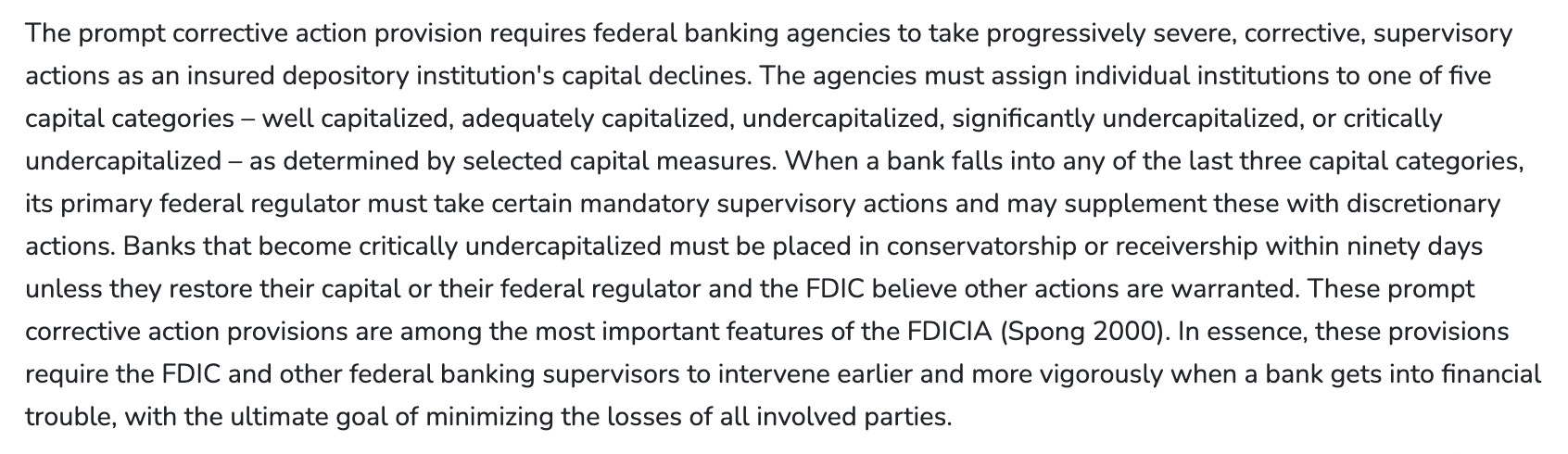 Text: The prompt corrective action provision requires federal banking agencies to take progressively severe, corrective, supervisory actions as an insured depository institution's capital declines. The agencies must assign individual institutions to one of five capital categories – well capitalized, adequately capitalized, undercapitalized, significantly undercapitalized, or critically undercapitalized – as determined by selected capital measures. When a bank falls into any of the last three capital categories, its primary federal regulator must take certain mandatory supervisory actions and may supplement these with discretionary actions. Banks that become critically undercapitalized must be placed in conservatorship or receivership within ninety days unless they restore their capital or their federal regulator and the FDIC believe other actions are warranted. These prompt corrective action provisions are among the most important features of the FDICIA (Spong 2000). In essence, these provisions require the FDIC and other federal banking supervisors to intervene earlier and more vigorously when a bank gets into financial trouble, with the ultimate goal of minimizing the losses of all involved parties.
Loading quoted Bluesky post...
Steve Randy Waldman
@interfluidity.com
how fair or unfair is this characterization of Paul, Weiss and its relationship to the erstwhile Democratic establishment? (i'm not interested in opinions on the piece's author, @matthewstoller.bsky.social. i know those are colorful.) www.levernews.com/how-big-law-...
How Big Law Killed The Democrats
Link Preview: How Big Law Killed The Democrats: A group of elite lawyers is playing for all sides — and it’s costing the American people.
Steve Randy Waldman
@interfluidity.com
this is a date to which one really ought attach the year.
Loading quoted Bluesky post...
Steve Randy Waldman
@interfluidity.com
Loading quoted Bluesky post...
Steve Randy Waldman
@interfluidity.com
“Right wing accelerationism is not a backlash *against* globalization and its combination of exit and constraint, but an argument that its logic should be extended downwards into the nation state.” @himself.bsky.social www.programmablemutter.com/p/the-reacti... ht @williamcb.bsky.social
The reactionary right is not a monolith
Link Preview: The reactionary right is not a monolith: J.D. Vance is trying to cover the cracks
Steve Randy Waldman
@interfluidity.com
the law in its majesty permits rich and poor alike to hand out million dollar checks to buy votes.
Steve Randy Waldman
@interfluidity.com
is WHCA pronounced Vichy?
Loading quoted Bluesky post...