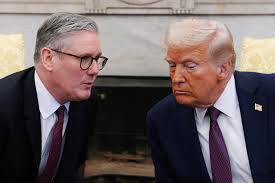
i wonder what the chatter is like among servicemen and attachés stationed abroad, working among allies in NATO roles.
does it encourage only infill housing development, or also greenfield new neighborhoods/ districts / cities?
why yes, there was, a whole right-wing media organization as I recall. apnews.com/article/russ...
Right-wing influencers were duped to work for covert Russian operation, US says
Link Preview: Right-wing influencers were duped to work for covert Russian operation, US says: An indictment alleges a media company linked to six conservative influencers — including Tim Pool, Dave Rubin and Benny Johnson — was secretly funded by Russian state media employees.i’ve got to say i’ve become resistance-lib, Putin-puppet paranoid. Gaza is undoing any claim the US might have as human rights guarantor. but we still had a Westphalian, we-support-territorial-integrity high ground to wield against Putin (and maybe Xi). this stuff seems tailored to undo that.
all China can do is kill the value of the dollar against CNY, which it probably doesn't want to do, because both for domestic growth and geopolitical reasons, it wants to sell to the US, not price out US consumers. changing the status of USD would take coordinated multilateral change.
Long-bond buyers would appear with sufficiently credible forward guidance by the Fed, and of course with QE. The only constraint on the Fed's ability to manage the bond market is inflation. They may need yields to rise, if deficits and trade wars end up putting pressure on domestic prices.
USD dependence will be a habit very hard to break. I think if we want to keep our reserve currency status, we could keep it, it wouldn't be very hard. We just would have to not egregiously piss core users off. But as you say, we might inflict wounds on ourselves. Trump is off to a good start.
Yes. I know the history. And I know a lot of people conspiratorially overstate the cohesion of the BRICs. Nevertheless, despite the group's very random start, they do represent a hodgepodge of countries unhappy with the US-led order or fearful and looking to hedge the possibility of its end. 1/
I think reserve-currency status leads to complicated things, some good and some bad for the US. I'm not sure what everything else you're referring to. 1/
But I think reserve-currency status, for better and for worse, is sustained in part by the military protection we offer allies, and a tacit understanding that standardizing on USD is part of the arrangement. 2/
If we are going to destabilize the sense of stable alliance with important, pretty rich allies, we should do it with eyes open about a potential effect on willingness to hold the currency. 3/
Encouraging a shift from the US dollar might be a net positive for the US! 4/
"Exorbitant privilege" in terms of noninflationary expenditure is offset by "exorbitant burden" in terms of drain on domestic demand and impetus toward deindustrialization. Different people can weigh the costs and benefits differently. 5/
(Trump seems to value USD reserve currency though, since he threatens retaliation against countries that seem to pursue an alternative to the dollar.) 6/
i think the more successful organized crime rackets let you know it's a dangerous world, you really need protection, it isn't really optional. but if you pay and pay regularly they treat you to some degree like a customer, and refrain from busting your kneecaps unless you give them trouble.
tribute is a price paid for protection. a protection racket perhaps, but there’s no point paying the tribute if they’ll kneecap you anyway. there are some contradictions even in the most cynical readings of US behavior.
India is jealously nonaligned but wants to be part of a US-led Pacific security bloc. I agree with you, I think, that America's core alliances now are Pacific. Note that the allies Trump is threatening are only European and North American. His pivot to Asia tosses the rest on the garbage heap.
i don't think that's right. India does not treat China as an existential threat, despite even recently hot disputes. it's a complex mix of partner and security concern. European countries would be loathe to partner with Russia, but don't treat China as equivalent. Brazil sees threat in none of them.
(when i first started traveling to Romania there was an IT firm IDM whose logo was IBM's exactly unless you looked very carefully.)
(good piece. i think it's more likely a new unipolar system, or two largely decoupled systems would emerge, than anything that would be genuinely multipolar. it's conceivable a new quasimultipolar system could be coordinated around SDRs or something, but we are farther than ever from that.)
i'm not saying it's easy or any alternative is close. i'm saying that although coordination equilibria are hard to break, they are not impossible to break, and the more parties feel trapped and mistreated in the existing equilibrium the more potentially successful work will be done to break them.
I mostly agree. But the now broader group does also have some shared interests. Yes, they begin from a random investor note about which emerging markets happened to be booming. But that's of only historical interest now. 1/
The emerging group represents a coalition of governments with some degree of dissatisfaction towards what they perceive as an unjust status quo world order, or with some desire to hedge the potential end of that order. 2/
that's right. but between them, they are experimenting with alternative payments systems. i agree they are unlikely to become the new NATO. but i think they'd be glad to share a new SWIFT. so far their experiments haven't gone far. but really, it isn't rocket science. it'd be like BlueSky emerging.