
Steve Randy Waldman
@interfluidity.com
what if we just did the opposite of what would be smart? what happens then?
what if we just did the opposite of what would be smart? what happens then?
as long as in the end there is a Trump Tower — Kish, he will score the escapade a victory.
eclipse up close. ht @paulcrider.liberalcurrents.com
Loading quoted Bluesky post...
i think it’s not really a new thing. there are lots of spheres where we can’t easily distinguish high from low quality, education, finance, policy, etc. we have disagreements. 1/
when we decide individually, we can do whatever we do. but when we have to decide as some kind of collectivity, we usually seek some kind of authority, in some cases to help us choose, very often just to bless the choice some party prefers. (think McKinsey.) 2/
it’s that authority, making or blessing which of the infinitely many contradictory arguments the LLM will be happy to make for us, that I think will require a human, one with some kind of social capital that confers authority in the context. /fin
lots of wrinkles and caveats as there usually is with datasets like this, but data.bls.gov/oes/#/indust...

Occupational Employment and Wage Statistics
Link Preview: Occupational Employment and Wage Statistics
it’s a problem if your project is to use the identity of worker as a basis of structuring a politically potent and policy coherent movement towards a less unjust society. if not that’s your project, you may be unbothered. but it was once a project in which some of us invested some hope.
It definitely differs by field. But if you had to characterize the contemporary labor economy as like a 1950s factory, where any reasonably healthy pair of hands could learn to do the job vs backbiting for promotions at Google, I think you'd choose the latter. 1/
And it's the most remunerative sectors that are heterogenous, so even workers outside of those sectors would like, if they could, to enter them and contest, and feel psychologically like losers if they can't. /fin
i think it's more who gets to judge whether we're gonna go with this LLM output or try again. the role of the human will be to brand outputs as something worth trusting, which is the historical role of social capital. 1/
what does it mean to say Larry Summers had a lot of social capital? lots of people would disagree about economic phenomena and ideas. most people's ideas were ignored or dismissed, some were treated as valuable and important, branding by Larry Summers could move an idea into the latter category. 2/
LLMs are the rest of us, coming up with our ideas, often I'd argue much stronger than Larry's. But there will still be a social need to distinguish the ones worth taking seriously from the noise. That's the input those with social capital will provide. 3/
(they may in fact have a talent for distinguishing good ideas from less good, or they may make terrible choices. our situation is we face an information problem, we collectively have no means of telling apart good from bad, so we can't, over a short run, distinguish a good from a bad Larry.) 4/
(we just choose our Larrys and we go with them. Maybe eventually they face some risk of accountability, if we have any means ex post or over time of distinguishing good from bad. and that too is a big if.) /fin
OK. The argument is that during the Fordist era there was a class called "workers". Both the aggregate majority of consumption + an aspirational life at an individual level was financed by the largely fungible wage labor of that class. To be a "worker" was to be a successful middle class person. 1/
That is no longer true. Neither the aggregate majority of consumption nor an individually aspirational life can be financed out of wage labor broadly accessible to trainable humans with time and hands. Wage laborers of that sort still exist, but they have been demoted as a class. 2/
Most consumption, and any aspirational life, is financed from the income of people with wealth, or who earn unusual wages because they are situated in ways other cannot easily reproduce for the performance of labor decoupled from time. 3/
Where it was once a reasonable and hopeful project that we could all self identify and respect one another as workers, it no longer is. We live in a society where some workers are winners, and many are perceived and self-perceive as losers. 4/
We therefore understandably aspire to what distinguishes workers, rather than what they have in common. The identity "worker" no longer, um, works as a means of constructing a shared way of living that would yield a reasonably just society. /fin
Yes! I think that's exactly right. It's not that this is a new condition. It's that it's an old one. The arc of history may not move monotonically.
The point isn't to find angels on a pin about saying 62% of your wages is due to social capital. We can rarely directly measure the share of contribution of factors of production (this is a huge problem for marginal product theory). 1/
The point is that "labor", given the admixture of social capital and "career", has changed from a category that was once relatively homogeneous and solidaristic (only for a brief period, between the mid 19th and 20th centuries) to one structured as a tournament with winners and losers. 2/
The project of building a mutualistic society cld once use the identity "worker" as a substrate or scaffolding. It made sense to call for workers of the world to unite. Once the bulk of "workers" becomes a heterogenous category of people in competition with one another, it's crabs in a bucket. /fin
It's certainly a threat to members of the class! Is it a threat to the class's domination itself? or does it simply ultimately render the class more exclusive, and membership therefore more valuable?
Thanks! And no I haven't, but I'll try to take a look.
I'd say it has value, but of a quite different character than mere commodity value. Who you are is as important as what you can do, not mostly for corrupt reasons, but bc of information problems + differing ability of some people to serve as authoritative in some sense in the face of those problems.
sorry!
sorry!
so, lots not quite right with this. labor's share of income as conventionally measured is no longer >60%. that it was roughly constant used to be taken as a stylized fact (Nicholas Kaldor characterized it as such), but it's been in steep decline since Y2K. fred.stlouisfed.org/series/LABSH... 1/
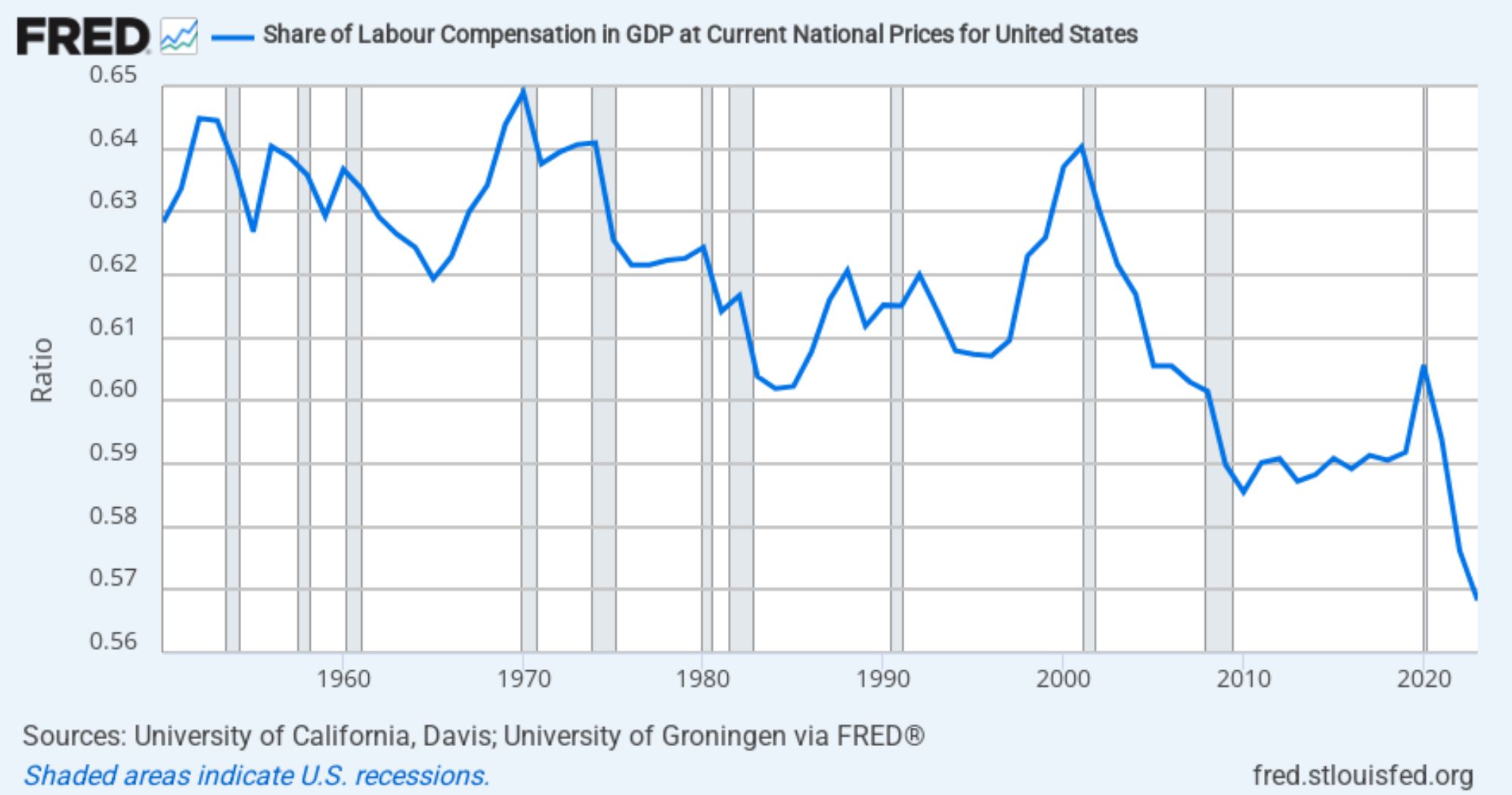
Share of Labour Compensation in GDP at Current National Prices for United States
Link Preview: Share of Labour Compensation in GDP at Current National Prices for United States: Share of Labour Compensation in GDP at Current National Prices for United States
more fundamentally, the denominator of GDP isn't the same as the source of purchasing power for consumption in a distributional sense. 2/
for example (calling @steveroth.bsky.social), the majority of income from wealth over time, over many decades, comes from capital gains, mere revaluation of claims, which is not included in GDP (or GDI) at all. yet you can spend from your appreciated stock as easily as you spend from dividends. 3/
(I think @steveroth.bsky.social publishes a labor-share series that adjusts for this.) 4/
More interestingly in this context is inequality within the broad category of what gets measured as "labor income". Thus the distinction I am trying to make between "career" as returns from social capital and wage labor. 5/
Both wage labor and returns to social capital show up as part of "labor share". But for the purposes of this conversation, they are profoundly distinct. 6/
The traditional left took for granted that nonsupervisory labor, the bulk of labor, took the form of hourly work, that human hours were imperfectly but largely substitutable, which imposed bounds on how divergent fortunes could be within a (by definition) proletariat. 7/
That has two implications: (1) A proletariat with somewhat similar, shared interest constitutes the bulk of society, collectively they would be powerful and their interests are in fact aligned; and (2) a society organized around and on behalf of such a proletariat would be not be too unjust. 8/
Because they constitute most of the beyond-home labor force, and because their claims to production are based on the same clock + similar hands, a society on behalf of workers of the world not be perfectly equal, but wld not suffer the huge spreads in fortune and misfortune of (some) capitalisms. 9/
Social capital and the, um, democratization of the modern "career" break this logic entirely. Lots of what gets coded as labor income is independent of measured time working. In lots of roles, you might take a salary earn hundreds of thousands of dollars with no tracking at all of time spent. 10/
I'm not commenting here on whether that work is adequately productive to justify the wage or not. Undoubtedly sometimes yes, sometimes no, it's just a sinecure. But that's not the point. 11/
The dispersion of remuneration of this kind of work makes it look more like capital income than labor income. The "social capital" we often impute that remuneration as being a return too is not freely and competitively available to its most capable user. It's bound to identity and history. 12/
The traditional left, after Marx, sees affordances in the nature of wage labor that mean there's a proletariat that should perceive shared interest, and if society were governed in its interest, a society whose fruits were widely shared would emerge. The main group opposed would be capital. 13/
But the replacement of relatively compressed wage labor with widely divergent careers, the ascendance of the resumé or CV as a kind of capital, breaks this. 14/
Workers whose pay in high and entirely decoupled from measured time have interests that overlap with capital. Compression of remuneration toward norms bound by hours and hands would not be in their interest. 15/
Plus, because many of these "workers" earns a great surplus relative to ordinary incomes and lifestyles, they come to accumulate capital, so they blur the lines between traditional labor and capital. They are both. 16/
And they are the trendsetting class in contemporary society, the definers of what constitutes a good life. 17/
(@brankomilan.bsky.social has coined a term "homoploutia" or "homoploutic" to characterize this group.) 18/
That this has become the dominant class breaks the traditional left. One doesn't become awesome in our society through solidaristic wage labor. One doesn't even make it to not-a-loser category through selling readily substitutable hours. 19/
Increasing returns to work among the homoploutic is about distinguishing yourself from other workers, and decoupling your remuneration from anything measurable as time, both via how you are paid as a "worker", and via capital income. 20/
Americans don't think of themselves aspirationally as just workers any more, because being a simple work yields an underclass to lower-middle-class life, with lots of precarity. It yields no prestige, no belonging to a club of proud, stable people. 21/
What's aspirational is a "career". But there is little solidarity in careerism. Although professionals do have some common interests, they are competitors for higher places in tournaments with widely divergent outcomes. 22/
And that wide divergence of outcomes means a society organized by + for professionals wouldn't necessarily have the middle-class character of an old-school workers-of-the-world society. It might not be all that different than a society organized by and on behalf of capital. 23/
They might even join forces, which, in a nutshell, is, in my view, the story of the neoliberal era the backlash to which we are now struggling to collectively survive. /fin
maybe, john roberts, an independent executive's "bold and unhesitating action" is not, after all, more important than keeping him accountable to the constitution, to law, to humanity itself.
(it occurs to me the tweet you are responding to is ambiguously written, i'm saying returns to other than wage labor, then instead of that returns either to wealth or social capital. i'm not saying it's returns to none of those things.)
i think the tacitly much of our leadership is like, "well look, braying brimstone like a cartoon villain is his brinkmanship on behalf of the U.S. of A. it would be *unpatriotic* to undermine that. if everything really does go to hell i can condemn it afterward and pretend i opposed it before."