Steve Randy Waldman
@interfluidity.com
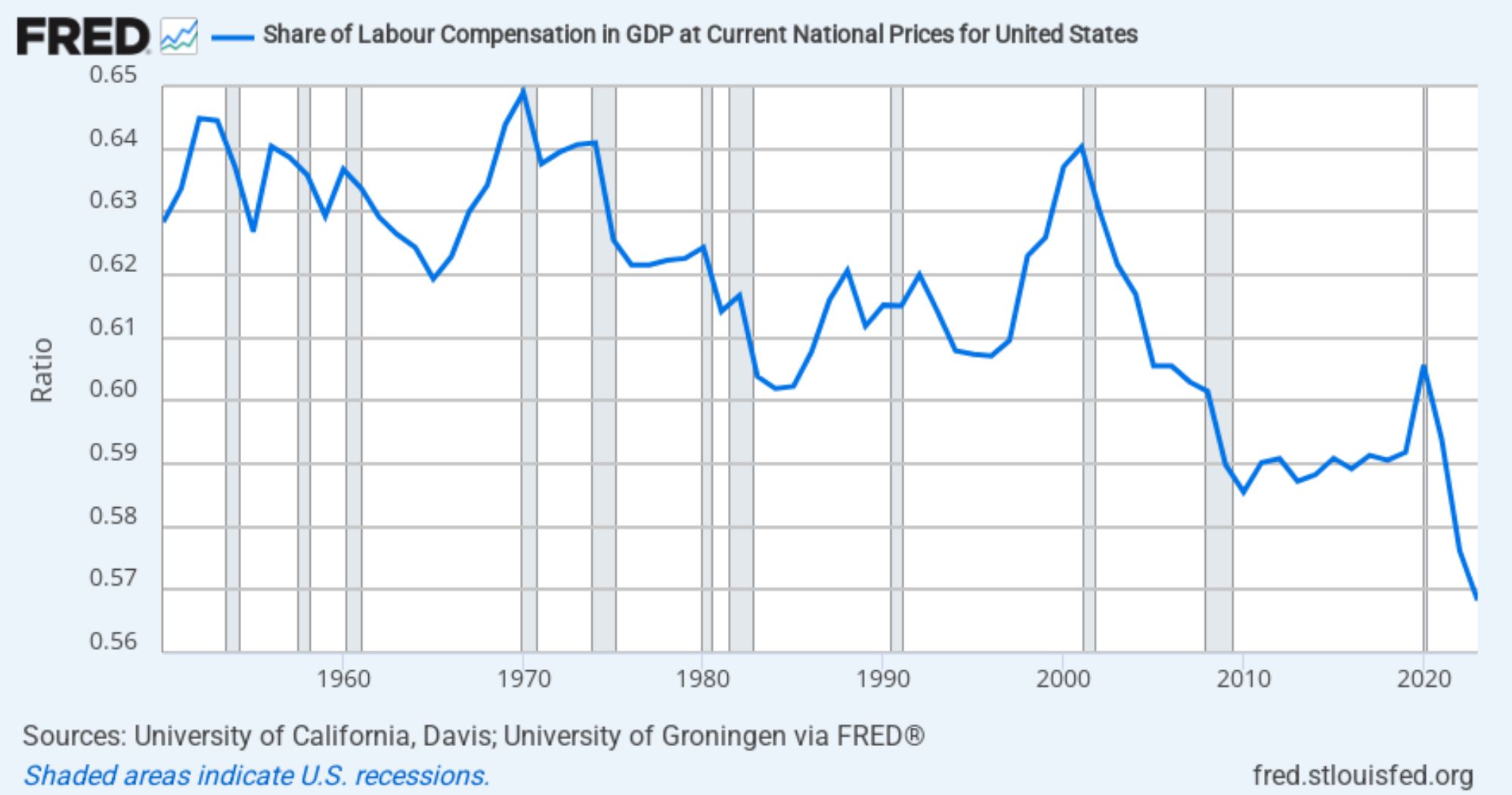
so, lots not quite right with this. labor's share of income as conventionally measured is no longer >60%. that it was roughly constant used to be taken as a stylized fact (Nicholas Kaldor characterized it as such), but it's been in steep decline since Y2K. fred.stlouisfed.org/series/LABSH... 1/
Share of Labour Compensation in GDP at Current National Prices for United States
Link Preview: Share of Labour Compensation in GDP at Current National Prices for United States: Share of Labour Compensation in GDP at Current National Prices for United States
Steve Randy Waldman
@interfluidity.com
more fundamentally, the denominator of GDP isn't the same as the source of purchasing power for consumption in a distributional sense. 2/
Steve Randy Waldman
@interfluidity.com
for example (calling @steveroth.bsky.social), the majority of income from wealth over time, over many decades, comes from capital gains, mere revaluation of claims, which is not included in GDP (or GDI) at all. yet you can spend from your appreciated stock as easily as you spend from dividends. 3/
Steve Randy Waldman
@interfluidity.com
(I think @steveroth.bsky.social publishes a labor-share series that adjusts for this.) 4/
Steve Randy Waldman
@interfluidity.com
More interestingly in this context is inequality within the broad category of what gets measured as "labor income". Thus the distinction I am trying to make between "career" as returns from social capital and wage labor. 5/
Steve Randy Waldman
@interfluidity.com
Both wage labor and returns to social capital show up as part of "labor share". But for the purposes of this conversation, they are profoundly distinct. 6/
Steve Randy Waldman
@interfluidity.com
The traditional left took for granted that nonsupervisory labor, the bulk of labor, took the form of hourly work, that human hours were imperfectly but largely substitutable, which imposed bounds on how divergent fortunes could be within a (by definition) proletariat. 7/
Steve Randy Waldman
@interfluidity.com
That has two implications: (1) A proletariat with somewhat similar, shared interest constitutes the bulk of society, collectively they would be powerful and their interests are in fact aligned; and (2) a society organized around and on behalf of such a proletariat would be not be too unjust. 8/
Steve Randy Waldman
@interfluidity.com
Because they constitute most of the beyond-home labor force, and because their claims to production are based on the same clock + similar hands, a society on behalf of workers of the world not be perfectly equal, but wld not suffer the huge spreads in fortune and misfortune of (some) capitalisms. 9/
Steve Randy Waldman
@interfluidity.com
Social capital and the, um, democratization of the modern "career" break this logic entirely. Lots of what gets coded as labor income is independent of measured time working. In lots of roles, you might take a salary earn hundreds of thousands of dollars with no tracking at all of time spent. 10/
Steve Randy Waldman
@interfluidity.com
I'm not commenting here on whether that work is adequately productive to justify the wage or not. Undoubtedly sometimes yes, sometimes no, it's just a sinecure. But that's not the point. 11/
Steve Randy Waldman
@interfluidity.com
The dispersion of remuneration of this kind of work makes it look more like capital income than labor income. The "social capital" we often impute that remuneration as being a return too is not freely and competitively available to its most capable user. It's bound to identity and history. 12/
Steve Randy Waldman
@interfluidity.com
The traditional left, after Marx, sees affordances in the nature of wage labor that mean there's a proletariat that should perceive shared interest, and if society were governed in its interest, a society whose fruits were widely shared would emerge. The main group opposed would be capital. 13/
Steve Randy Waldman
@interfluidity.com
But the replacement of relatively compressed wage labor with widely divergent careers, the ascendance of the resumé or CV as a kind of capital, breaks this. 14/
Steve Randy Waldman
@interfluidity.com
Workers whose pay in high and entirely decoupled from measured time have interests that overlap with capital. Compression of remuneration toward norms bound by hours and hands would not be in their interest. 15/
Steve Randy Waldman
@interfluidity.com
Plus, because many of these "workers" earns a great surplus relative to ordinary incomes and lifestyles, they come to accumulate capital, so they blur the lines between traditional labor and capital. They are both. 16/
Steve Randy Waldman
@interfluidity.com
And they are the trendsetting class in contemporary society, the definers of what constitutes a good life. 17/
Steve Randy Waldman
@interfluidity.com
(@brankomilan.bsky.social has coined a term "homoploutia" or "homoploutic" to characterize this group.) 18/
Steve Randy Waldman
@interfluidity.com
That this has become the dominant class breaks the traditional left. One doesn't become awesome in our society through solidaristic wage labor. One doesn't even make it to not-a-loser category through selling readily substitutable hours. 19/
Steve Randy Waldman
@interfluidity.com
Increasing returns to work among the homoploutic is about distinguishing yourself from other workers, and decoupling your remuneration from anything measurable as time, both via how you are paid as a "worker", and via capital income. 20/
Steve Randy Waldman
@interfluidity.com
Americans don't think of themselves aspirationally as just workers any more, because being a simple work yields an underclass to lower-middle-class life, with lots of precarity. It yields no prestige, no belonging to a club of proud, stable people. 21/
Steve Randy Waldman
@interfluidity.com
What's aspirational is a "career". But there is little solidarity in careerism. Although professionals do have some common interests, they are competitors for higher places in tournaments with widely divergent outcomes. 22/
Steve Randy Waldman
@interfluidity.com
And that wide divergence of outcomes means a society organized by + for professionals wouldn't necessarily have the middle-class character of an old-school workers-of-the-world society. It might not be all that different than a society organized by and on behalf of capital. 23/
Steve Randy Waldman
@interfluidity.com
They might even join forces, which, in a nutshell, is, in my view, the story of the neoliberal era the backlash to which we are now struggling to collectively survive. /fin