
Steve Randy Waldman
@interfluidity.com
cold, man. faint praise.
cold, man. faint praise.
i’m glad to hear it. (i’m probably more and more wobbly!)
a man who has starved and/or withheld lifesaving medical assistance from hundreds of thousands of people thinks Joyce Carol Oates is mean.
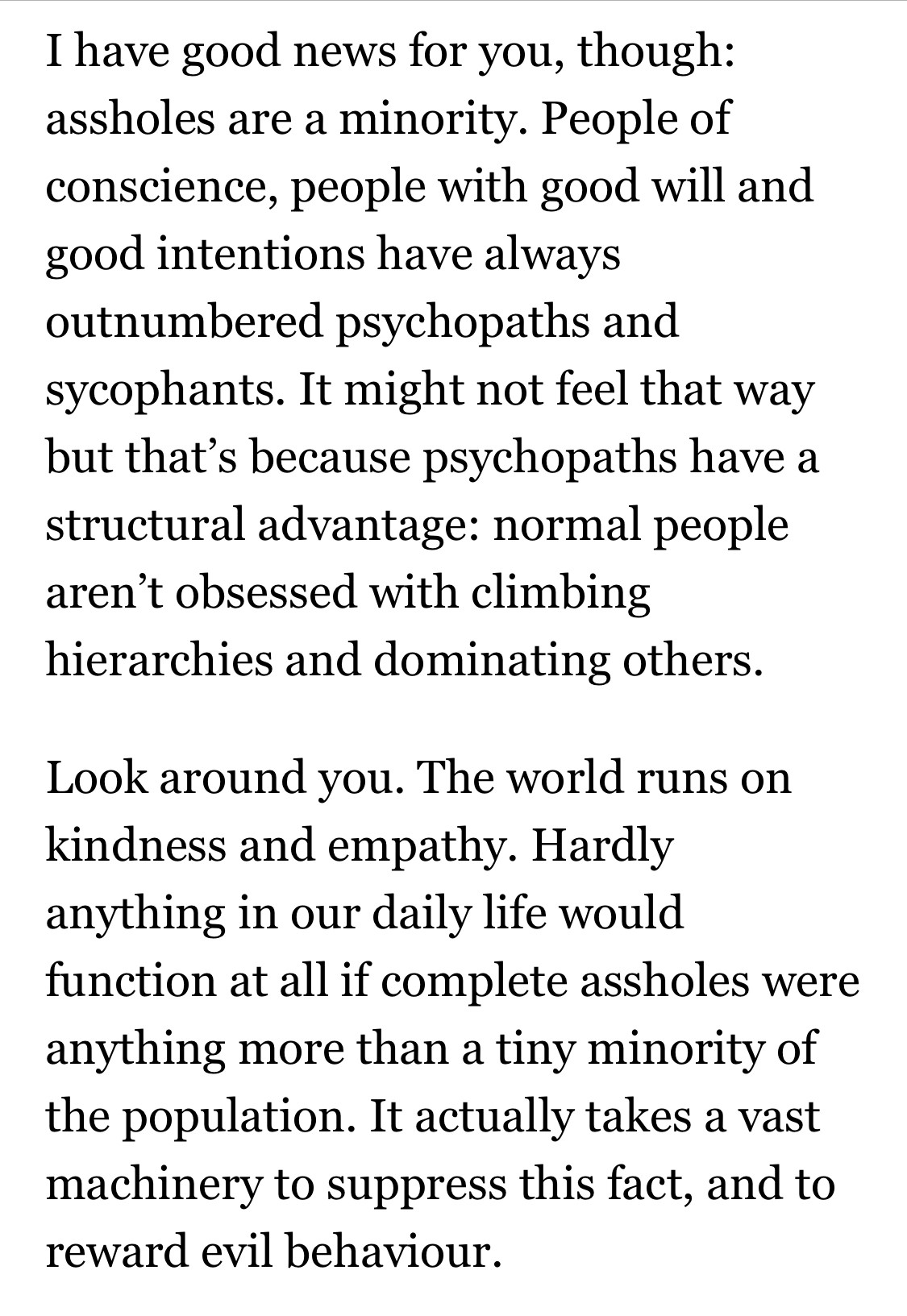 Text: I have good news for you, though: assholes are a minority. People of conscience, people with good will and good intentions have always outnumbered psychopaths and sycophants. It might not feel that way but that's because psychopaths have a structural advantage: normal people aren't obsessed with climbing hierarchies and dominating others. Look around you. The world runs on kindness and empathy. Hardly anything in our daily life would function at all if complete assholes were anything more than a tiny minority of the population. It actually takes a vast machinery to suppress this fact, and to reward evil behaviour.
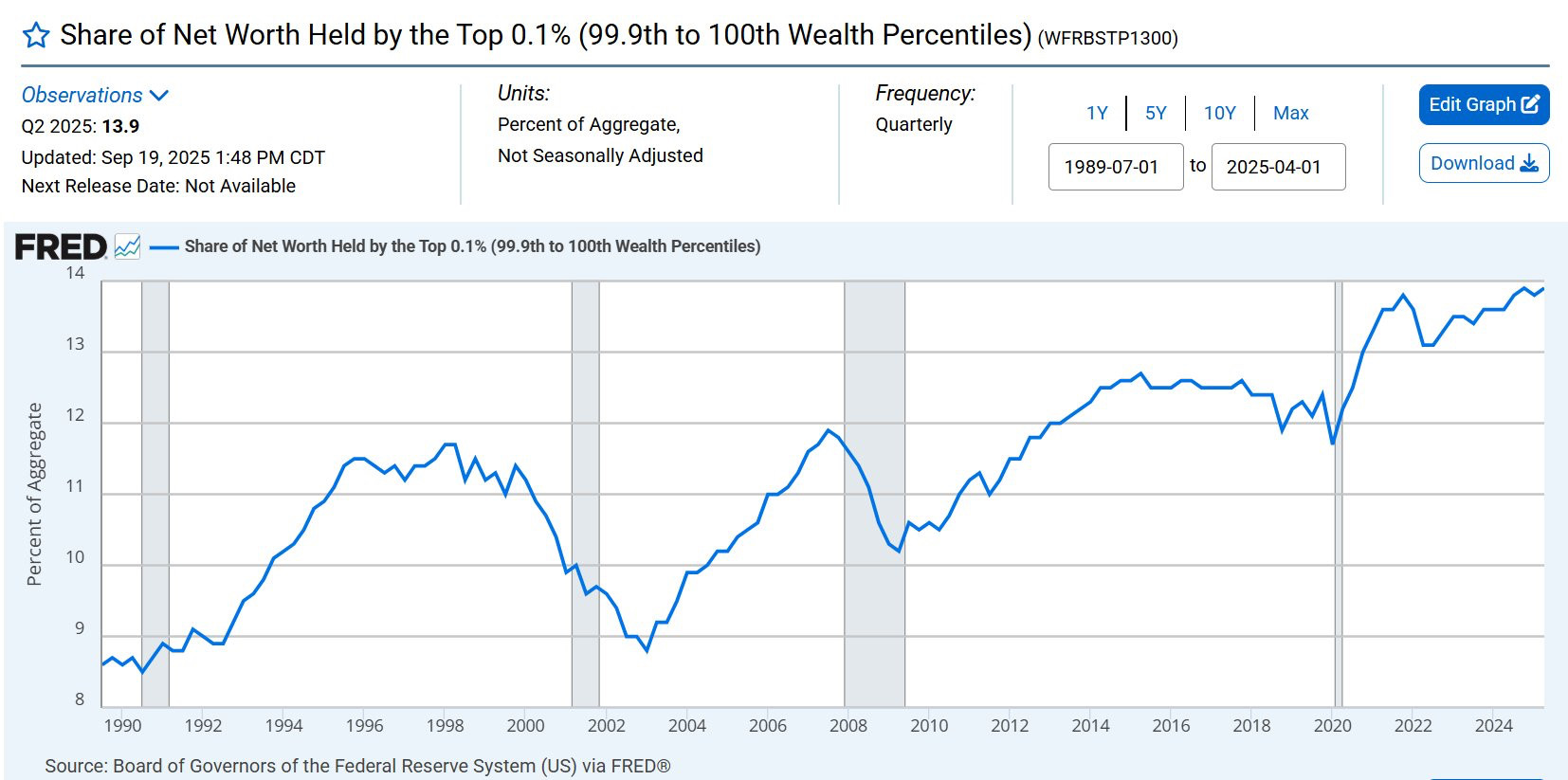
“It’s Difficult To Overstate How Concentrated Wealth Is In The US” by @ianwelsh.bsky.social www.ianwelsh.net/its-difficul...
It’s Difficult To Overstate How Concentrated Wealth Is In The US
Link Preview: It’s Difficult To Overstate How Concentrated Wealth Is In The US: These two charts tell a story. First, the top .1%. Next, the top 1%. This chart is only to 2023. Now what you'll notice is that the top .1% holds about half the wealth of the top 1%. It's like this al...
i feel like dementia is aspirational now, given how many famous powerful people now have it.
that’s precisely what distinguishes social insurance from market insurance. people buy market insurance voluntarily, knowing everything they know. 1/
social insurance is compelled or subsidized, because the people who participate already know whether they’re more likely to get better deals or worse out of it, but collectively we have an interest in compressing outcomes, so we compel participation. /fin
Really? Here are the Michigan Consumer Survey questions from 2015. data.sca.isr.umich.edu/fetchdoc.php... 1/
Do they capture what we care about, in terms of long-term economic welfare? Are you financially better off or worse off than five years ago? How are business conditions? What do you expect of inflation? How's the housing market? 2/
Is that "economic welfare" in any meaningful sense? If you have more savings than five years ago, but you're struggling to make ends meat 'cuz your kid's in college and rent's gone up, are you "financially better off"? 3/
If you think gas prices are going to decline, what's the relationship between that and economic welfare? 4/
These measures were never intended or designed to be used in the manner you are using them. They are intended to help make short-term predictions about the business cycle. That's what they were developed for. 5/
I agree the suicide rate is a very dirty measure. But it is more condign to the task of measuring welfare, the object of economics, than short-term consumer sentiment surveys. Yes. It's a bad measure! All the measures are bad! That is real life. 6/
You don't get to trump an argument because you have a measure, a very bad measure, but it is quantitative and you can find it on FRED! That is cargo cultism, not intelligence. /fin
The first Trump term was a cyclical uptick among a secular downturn. You'll object, by what measure? It's a hard question! Consumer sentiment surveys are weak predictors of anything, designed to capture cyclical not secular changes. Here's a measure, also dirty. www.nimh.nih.gov/health/stati...
I never said people were always upset and anxious. I said a lot of people have been upset and anxious since at latest 2016, and it's obviously true. 1/
There are all kinds of "measures if economic optimism", but we had a national debate over deaths of despair during that period, and an election in 2020 where one major political party's primaries were devoted very disproportionately to the cost of health care. 2/
Trump's first term may not be by some measures the worst of times economically, but we've been in a period of widely expressed dissatisfaction and disillusionment with the US economy since at least the financial crisis, through the volatility of the business cycle. /fin
(we had populist revolts, from the left and the right, in 2016, which many people understood at the time in materialist terms. there were arguments about it, you might remember. i think "everyone seemed pretty optimistic" until 2021-ish is not a defensible claim.)
“just asking questions”
@jwmason.bsky.social as Green New Kalecki. (i think he’s right. @schwarz.bsky.social’s “iron law of institutions” applies to particular capitalists and the economy at large. they’d accept economic collapse and catastrophe if that’s what preserves their own capacity to control.)
Loading quoted Bluesky post...
this is why the polity should organize itself through professional representatives, capable of memory and coherence, communicating actively with the represented and bound to pursue their interests. in the United States we’ve created an institutional environment in which this is impossible, however.
Loading quoted Bluesky post...
somewhere there is a Cave, mysterious and magical, a Cave of Paradoxes. how, for example, can one outrage a squish? and yet. look around.
❤️
people say Trump has really coarsened our politics, but pretty much everyone who interacts with him says “pardon me”.
i sometimes run into Freedom on Mastodon, but not too recently alas. i’ve been less abroad the last decade and a half or so, but may be more abroad soon. i’m not so likely to make it to an ML thing in Spring, though i enjoyed a flurry of texts from the recent reunion. 1/
how have you been all these decades, this blink of an eye? /fin
one can talk about labor augmenting vs labor replacing change, but in practice it’s a pretty blurry distinction? if one service provider is augmented to do the work of ten, you need a lot of help on the demand side to sustain bargaining power for good jobs. is the hope is for quality-not-quantity?
it’s a small world in either case, and delightful to find you.