Steve Randy Waldman
@interfluidity.com
it’s funny how we begin with Democrats are weak-kneed and need a more muscular, economics focused message and then all the rest is about how bad wokeness was at universities and we have to be sure not to go back to that. there’s a powerful message for the working class! fucking narcissists.
Opinion | ‘I Wouldn’t Say the Democrats Are in Good Shape’
Link Preview: Opinion | ‘I Wouldn’t Say the Democrats Are in Good Shape’
Steve Randy Waldman
@interfluidity.com
self-hosted jitsi is pretty great. jitsi.org
Free Video Conferencing Software for Web & Mobile | Jitsi
Link Preview: Free Video Conferencing Software for Web & Mobile | Jitsi: Learn more about Jitsi, a free open-source video conferencing software for web & mobile. Make a call, launch on your own servers, integrate into your app, and more.
Loading quoted Bluesky post...
Steve Randy Waldman
@interfluidity.com
in the MAGA army, there is no mercy for the man who fails to win the news cycle.
Steve Randy Waldman
@interfluidity.com
does anyone else think it’s irresponsible how they dox all the actors in the credits?
Steve Randy Waldman
@interfluidity.com
i agree that people who wouldn’t bother to vote wouldn’t, for the most part, participate in a general strike, but i think a lot of people who didn’t bother to vote in November ‘24 would bother to vote now if they only had the chance.
Steve Randy Waldman
@interfluidity.com
( i’ve written about this a bit, www.interfluidity.com/v2/9028.html )
Steve Randy Waldman
@interfluidity.com
today you are a carbon sasquatch.
Steve Randy Waldman
@interfluidity.com
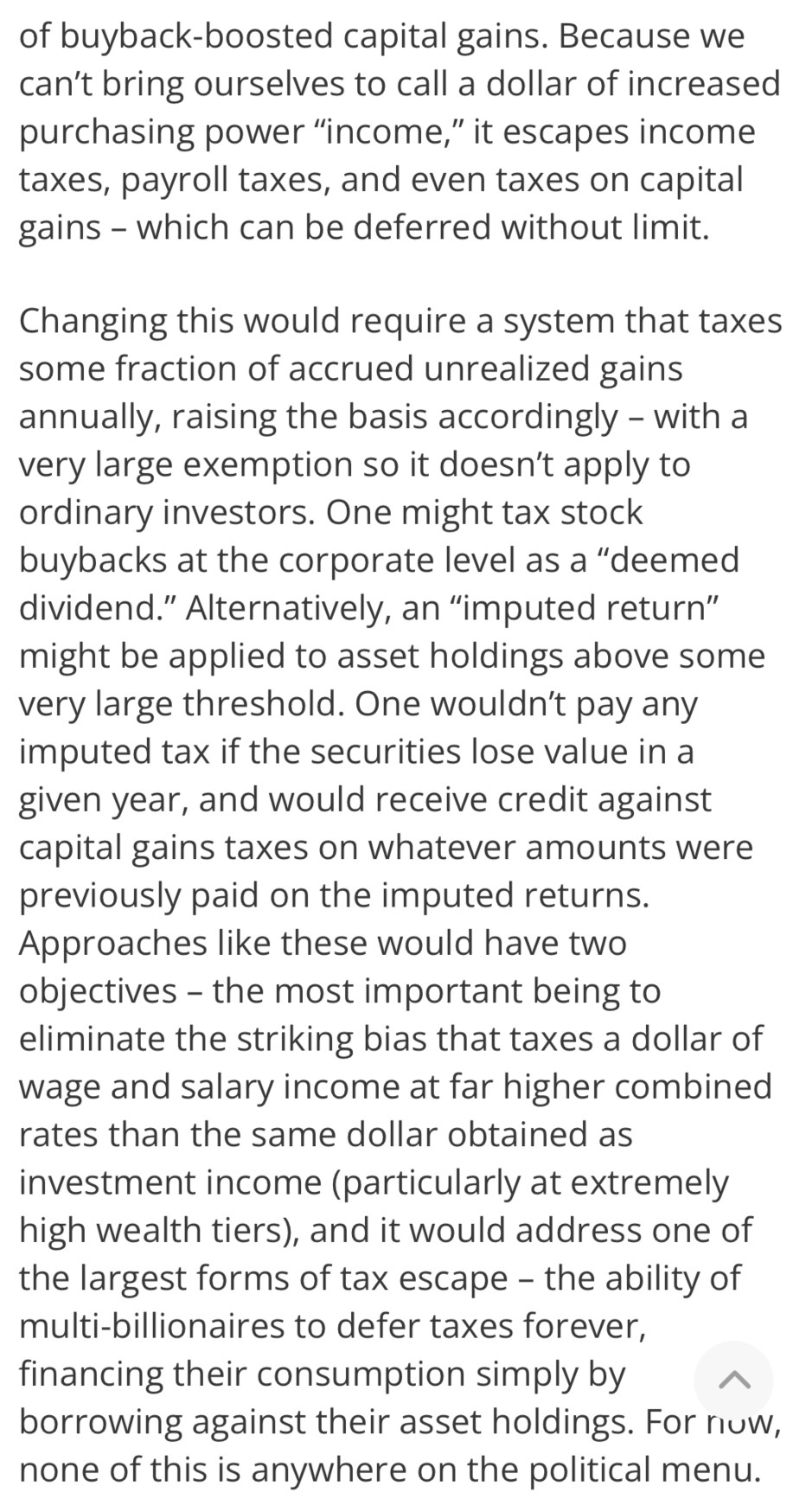 Text: Because we can't bring ourselves to call a dollar of increased purchasing power "income," it escapes income taxes, payroll taxes, and even taxes on capital gains - which can be deferred without limit. Changing this would require a system that taxes some fraction of accrued unrealized gains annually, raising the basis accordingly - with a very large exemption so it doesn't apply to ordinary investors. One might tax stock buybacks at the corporate level as a "deemed dividend." Alternatively, an "imputed return" might be applied to asset holdings above some very large threshold. One wouldn't pay any imputed tax if the securities lose value in a given year, and would receive credit against capital gains taxes on whatever amounts were previously paid on the imputed returns. Approaches like these would have two objectives - the most important being to eliminate the striking bias that taxes a dollar of wage and salary income at far higher combined rates than the same dollar obtained as investment income (particularly at extremely high wealth tiers), and it would address one of the largest forms of tax escape - the ability of multi-billionaires to defer taxes forever, financing their consumption simply by borrowing against their asset holdings. For now, none of this is anywhere on the political menu.
Steve Randy Waldman
@interfluidity.com
despite the bitter cold these are people who have no cool to lose.
Steve Randy Waldman
@interfluidity.com
methinks prisons will suffice.
Steve Randy Waldman
@interfluidity.com
we've developed a tool that supersedes and renders obsolete the guillotine. it's called taxation. we've never quite had the courage to deploy it as indicated.
Steve Randy Waldman
@interfluidity.com
the great thing about this approach is there’s no need for immigration police. the only people we ever deport are people who find themselves in the custody of the regular police anyway, for actually committing acts of violence.
Steve Randy Waldman
@interfluidity.com
Abolish ICE. If you want to enforce current immigration law, fine employers.
Steve Randy Waldman
@interfluidity.com
Impeach. Convict. Remove. Prosecute. Rinse. Repeat.
Steve Randy Waldman
@interfluidity.com
no good graph goes unpunished.
Steve Randy Waldman
@interfluidity.com
not after parties sort and negative polarization takes hold. then the threat the other guys might win largely obviates substantive negotiation.
Steve Randy Waldman
@interfluidity.com
“after all of those whom i resent have been crushed, i swear to you the world will be peaceful and good.”