
Steve Randy Waldman
@interfluidity.com
in 2016, i was a class reductionist, a Bernie bro, sensible moderate centrist Democrats kept telling me. "If we broke up the banks tomorrow, would that end racism? Would that end sexism?" 1/
in 2016, i was a class reductionist, a Bernie bro, sensible moderate centrist Democrats kept telling me. "If we broke up the banks tomorrow, would that end racism? Would that end sexism?" 1/
now those same pundits disdain me as a progressive, a "leftist", whose failure to disavow with sufficient energy the identity politics of which i was skeptical back then now has lost the election to the fascists (who they won't call that, to whom they are now building sensible moderate bridges). 2/
i don't think it is my position that has changed. /fin
what if we just planted an American flag on the glacier next to an ice cold keg of Bud and see how the Danes respond to that.
i mean, if they still had houses.
(now i feel very mean. i really am sorry for everybody, celebrity or uncelebrated, who lost their homes. it really is a terrible trauma.)
it must really suck if your house got burned down and you didn’t even make the cut for the “celebrity-owned homes” list.
Loading quoted Bluesky post...
just because you’ve put it in a graph doesn’t mean that it’s a fact.
i have a take! (oh, no.) drafts.interfluidity.com/2024/06/04/e...
you just say “large, dated hotel complex” and i think The Shining.
so, maybe Chesterton’s observation is understandable in his native UK. i’m skeptical that anarchism was so strong among the working class in the US, but i’m glad to be disabused. yeah, i don’t think severe propertarian limited government liberalism would be a working class thing almost anywhere.
it may have been (i don't know enough to say), but that doesn't get at the question. if it was a small movement, if a sliver of the working class constituted the whole of the movement, the generalization may hold. 1/
if you want to claim he's wrong, you'd want to claim a substantial portion of the working class were anarchist or sympathized with anarchism (or with upscale severely limited government liberalism) more than with other more dirigiste movements. which is possible, but i doubt. /fin
note that Chesterton's generalization is explicitly not about socialist or communist, only anarchist. his claim is that the poor want government, not anarchy. socialism and communism are both mostly strongly archic tendencies.
when speaking in generalizations about populations, the existence of exceptions is not much of an argument against the generalization. any generalization about "the poor" — or "the rich" or "MAGA" — will have counterexamples except to the degree they're excluded by definition of the category.
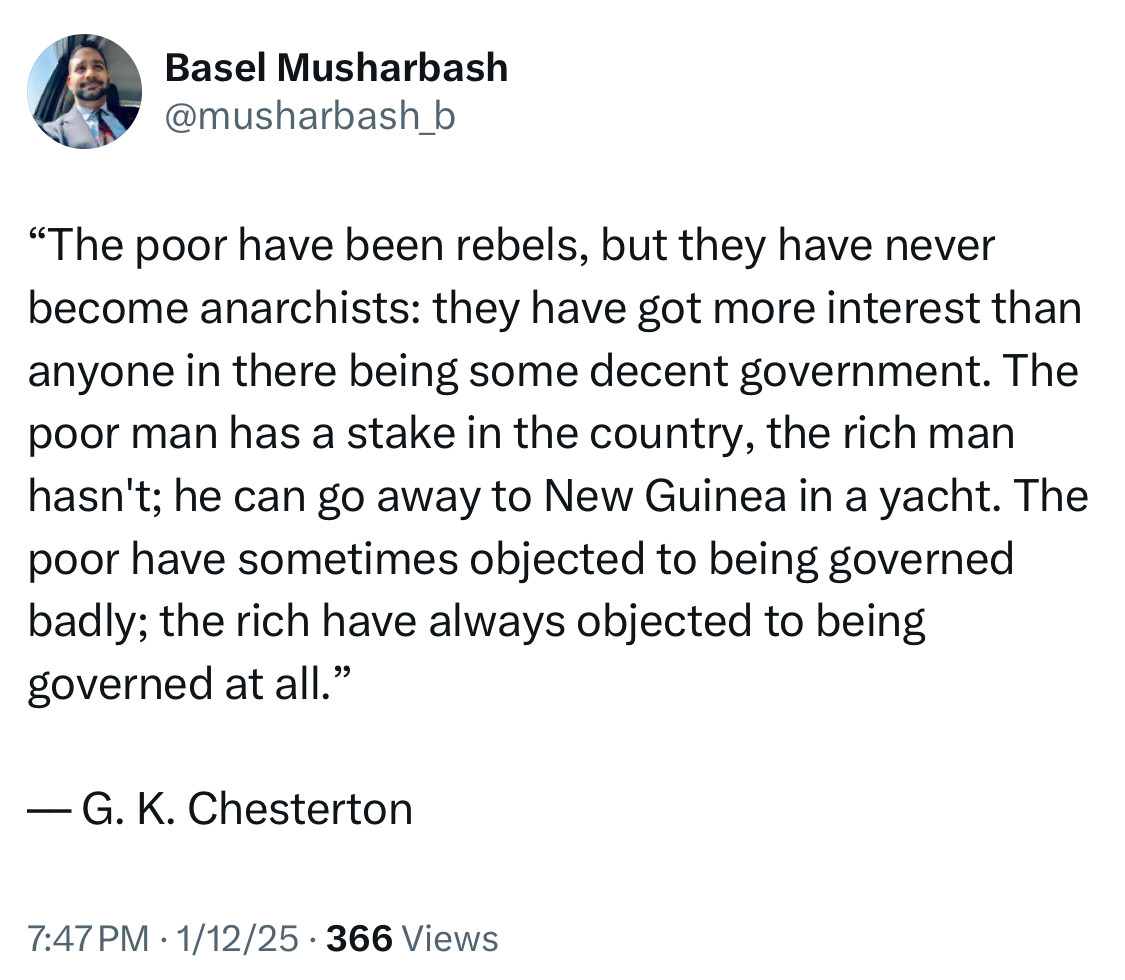 Screenshot of tweet by Basel Musharbash “The poor have been rebels, but they have never become anarchists: they have got more interest than anyone in there being some decent government. The poor man has a stake in the country, the rich man hasn't; he can go away to New Guinea in a yacht. The poor have sometimes objected to being governed badly; the rich have always objected to being governed at all.” –– G. K. Chesterton
cc @basel.bsky.social post here rather than there! or at least in addition to! we miss you!
Elon Musk is epistemological poison in a way Donald Trump never was. 1/
Donald Trump bullshits transparently. He lies constantly, changes his story with his interest, (almost) everybody understands that and looks through it into the values that are motivating the schtick (love them or hate them). 2/
Musk, on the other hand, affects himself a supergenius, a knower of truths. He attaches superficially plausible logics to his lies, concocts stories and “evidence” to support them is relentless support of persuading people to believe what he wants them to believe. 3/
In Trumpworld, there have been the Qs, frightening, but discernibly fringe, weird. 4/
Musk, with his determined activity, with the reach and the epistemological deference his money can buy, is intent on reshaping the mainstream with his tendentiously concocted stories. 5/
It’s working. Centrist institutions “triangulate” towards him. He increasingly defines one side a set of conventions that presume “both sides” equally worthy, equally suspect. Trump couldn’t really do that, because he couldn’t put together a platform, hold a consistent line. 6/
Trump was bad enough. But Musk and his crew are much worse. Under Trump, nothing was true, there were always alternative facts. Musk is molding lies of his choosing into a version of truth towards which much of our lucre-tropic society may quietly bend. /fin
that’s basically the usual deal with immigration. except often the “you can become one of us part” is left out.
Florida has no income tax, but loves to tax tourists.
the most obvious thing about offices is that it's land use that brings people into local commerce without imposing the costs that new residents incur. you don't need to build schools for new office development, the policing burden is lower, etc. 1/
jurisdictions do sometimes impose more direct taxes. San Francisco (in)famously imposes a gross receipts tax on businesses to cover homelessness-related expenses. i don't think that's so common though. 2/
i think it's mostly commercial development gives a similar short-term boost (fees, property tax before inflation kills it), also inspires other taxable commercial activity (especially if it generates taxable sales directly), while imposing fewer long-term costs. /fin
But commercial activity generates taxes beyond property taxes in ways that housing just does not. Prop 13 devalues property tax as a revenue source in favor of everything else. Housing is a source of costs, financially speaking, which a depreciating property tax can't offset.
(i'm not arguing incumbent residents don't also oppose housing! i am saying it matters that city officials look at their tax base and are vividly aware they earn pittances from older, established neighborhoods, and new housing eventually becomes that. there are, um, synergies.)
as long as my vegetables have quit smoking i figure i'm fine.
Prop 13 mean CA homeowners have their property tax bill capped, in the same way rent controls do for rents. 1/
Some might argue its different, because rent controls are alleged (sometimes reasonably, but often not) to hinder new apartment supply, while property tax caps don't affect supply through prices. house prices can still go up, indeed are inflated, by prop tax caps, so there's incentive to build. 2/
But in much of California, there is already plenty of price incentive to build. If projects could be quickly and cheaply permitted, developers would gladly add supply at current prices. 3/
It's permitting that's the actual bottleneck to supply, ad Prop 13 discourages permitting, as housing becomes a perishable tax base, compared to commercial land use. CA jurisdictions try to encourage jobs + commerce in their locality, hope someone else builds the housing. /fin
would you work in coalition with Steve Bannon to vanquish Elon Musk?