
Please do not edit this section.
@billseitz I paste my hard won, carefully articulated thoughts in a text box. I hit submit. I get no real acknowledgment. I end up either back on a contact page, or on some glitchy page thanking me for my "e-mail". It feels like throwing my words into the digital trash. If they had a meaningful system that sent receipt acknowledgement eg by e-mail, I'd gladly use the webforms. My experience is trash. I have no trust my words are saved or read or anything.
I'm going to be producing a lot of postal mail, I think. Very old school. Very time consuming. Our democracy in action. /fin
Trying to contact my Congresspeople. I want to write them. I mistrust their webforms. I want an e-mail address. So I phone to ask. 1/
I call Representative Anna Paulina Luna's office. Someone answers, but informs me that there is no e-mail, just the webform. Postal mail it will have to be. 2/
I try to call Senator Rick Scott's office. There's no phone number on his site, so I call his contact number listed on the official Florida delegation page of the US Senate. https://www.senate.gov/states/FL/intro.htm
Straight to voicemail, at 12:30-ish on Wednesday. 3/
On the same page, I find the phone number for my newly Senator, Ashley Moody.
Again, straight to voicemail. 4/
@Phil you'll get what you want. they need to secure themselves from us. they do understand that.
perhaps worse than a US withdrawal from NATO would be a US that sowed chaos from within the alliance. Europe still requires functional security arrangements.
one day a Russian prisoner is freed (Marc Fogel, great news). the next day the US Secretary of Defense concedes Ukraine’s territorial integrity and aspiration to join NATO. our transactional President sure knows how to strike a deal.
which is worse?
78.8%
consolidated fascism
(26 votes)
21.2%
chaotic collapse
(7 votes)
no one told us how entertaining the apocalypse could be.
or alternatively, the road to hell is paved with engaging content!
Newsom should announce a trip to Denmark for “exploratory talks”. https://universeodon.com/@Darkphoenix/113988599271616917
quite a price difference, apple books.
(tbf it's similar from other sources.)
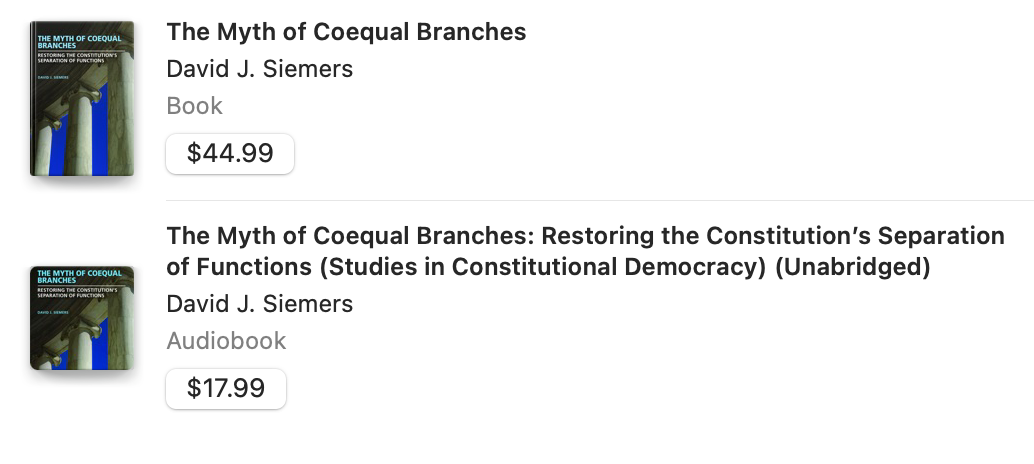 Screenshot of Apple Books pricing of "The Myth of Coequal Branches". e-book is $44.99, audiobook is $17.99.
@KimSJ @Chronotope (getting rid of them is my basic theory for why we should revise section 230) https://www.interfluidity.com/v2/8093.html
@megmac but it mustn't always be.
under this definition, hasn't Congress — the most important branch of the Federal government — been under "competitive authoritarianism" for decades?
see e.g. https://www.opensecrets.org/elections-overview/reelection-rates
from #StevenLevitsky #LucanAhmendWay https://www.foreignaffairs.com/united-states/path-american-authoritarianism-trump
ht @williamcb.bsky.social @casmudde.bsky.social
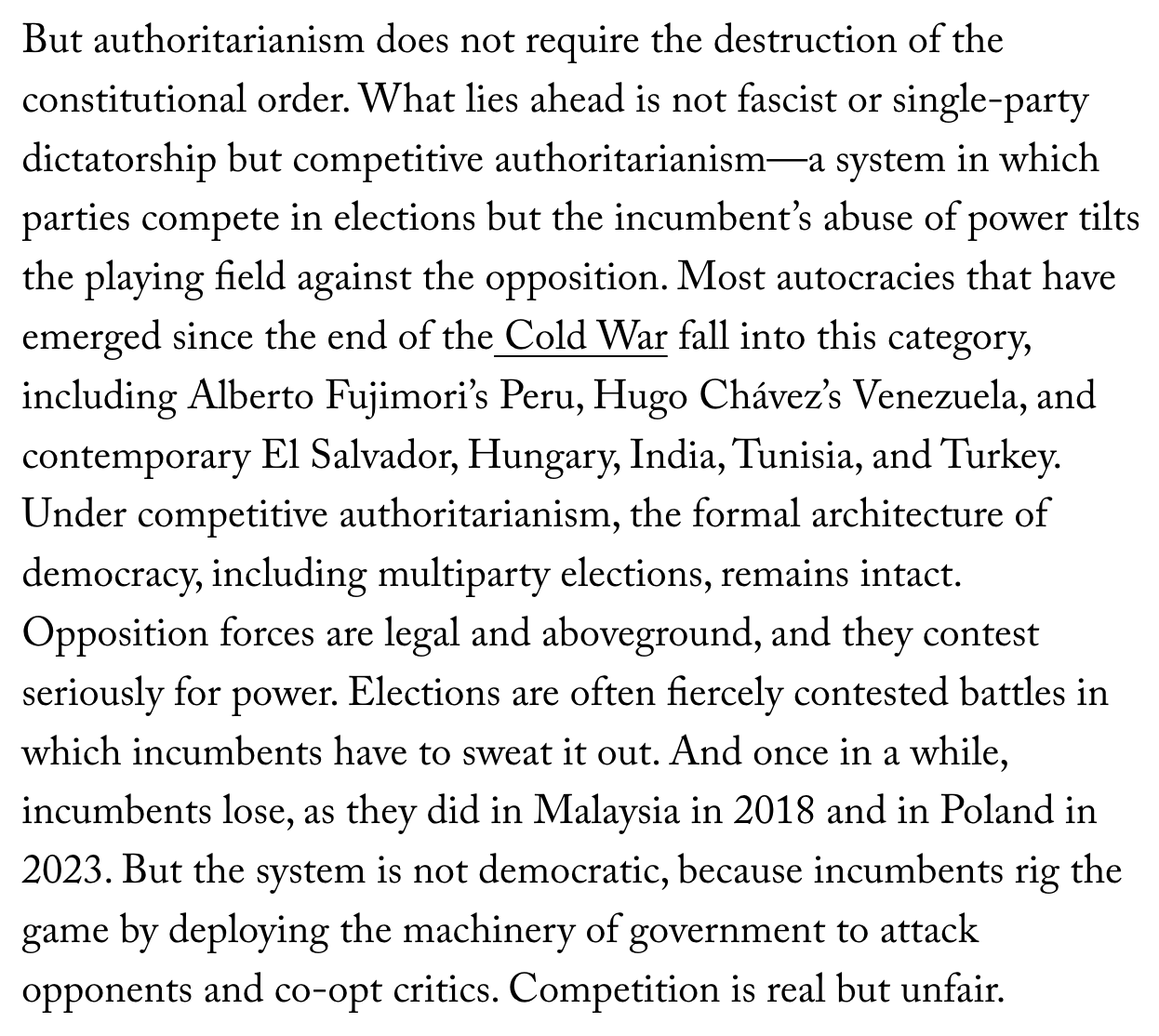 Text: But authoritarianism does not require the destruction of the constitutional order. What lies ahead is not fascist or single-party dictatorship but competitive authoritarianism—a system in which parties compete in elections but the incumbent’s abuse of power tilts the playing field against the opposition. Most autocracies that have emerged since the end of the Cold War fall into this category, including Alberto Fujimori’s Peru, Hugo Chávez’s Venezuela, and contemporary El Salvador, Hungary, India, Tunisia, and Turkey. Under competitive authoritarianism, the formal architecture of democracy, including multiparty elections, remains intact. Opposition forces are legal and aboveground, and they contest seriously for power. Elections are often fiercely contested battles in which incumbents have to sweat it out. And once in a while, incumbents lose, as they did in Malaysia in 2018 and in Poland in 2023. But the system is not democratic, because incumbents rig the game by deploying the machinery of government to attack opponents and co-opt critics. Competition is real but unfair.
@KimSJ @Chronotope i'm not sure he's disagreeing? isn't he suggesting that maybe a world of small, human-moderated fora would be better than presuming large, algorithmic fora are the norm? (he doesn't address a profit/non-profit distinction, but it seems to me he's challenging the status quo.)
from @Chronotope https://aramzs.xyz/thoughts/roost-must-prove-itself-good-thats-a-reasonable-request/
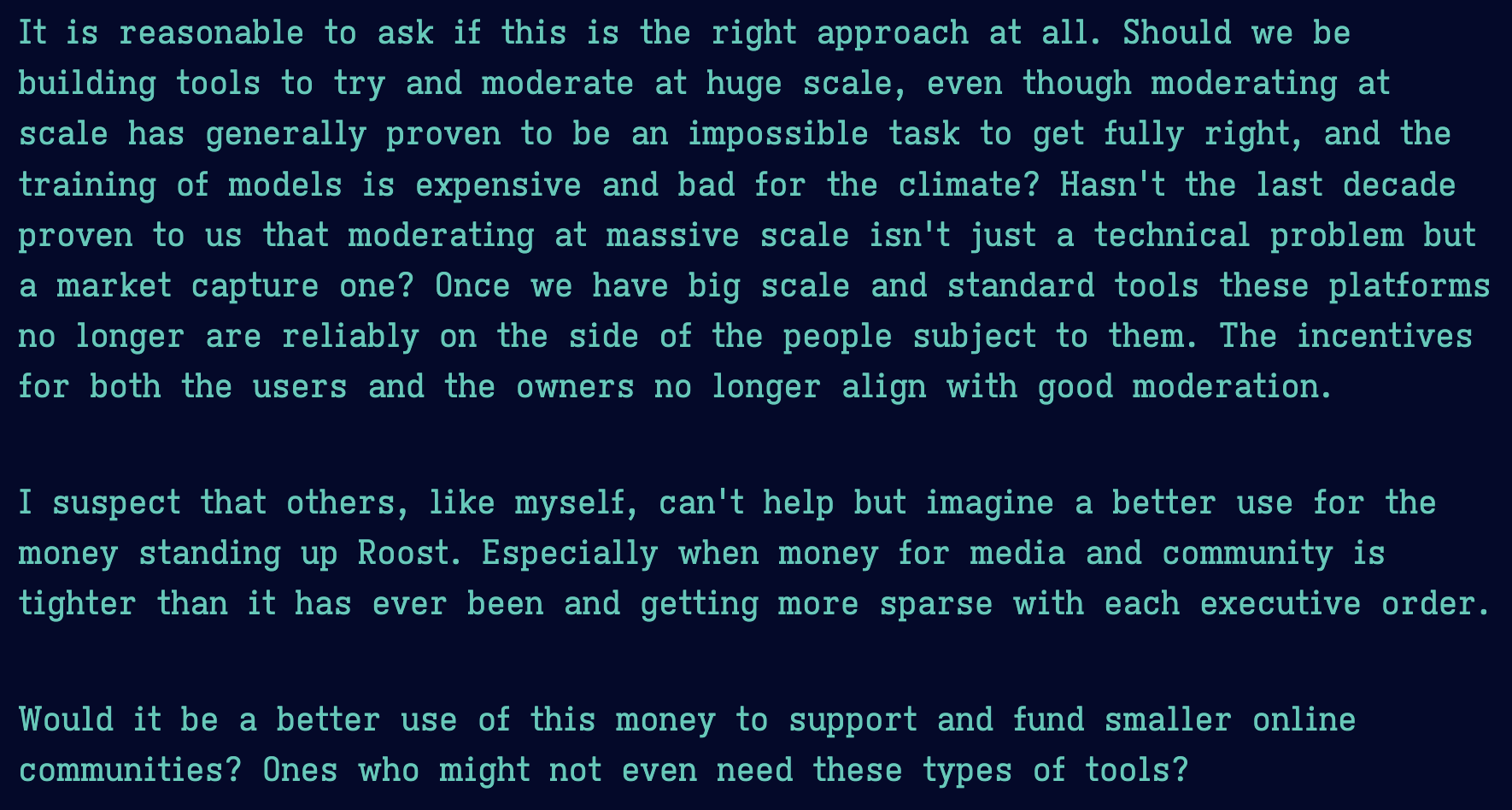 Text: It is reasonable to ask if this is the right approach at all. Should we be building tools to try and moderate at huge scale, even though moderating at scale has generally proven to be an impossible task to get fully right, and the training of models is expensive and bad for the climate? Hasn't the last decade proven to us that moderating at massive scale isn't just a technical problem but a market capture one? Once we have big scale and standard tools these platforms no longer are reliably on the side of the people subject to them. The incentives for both the users and the owners no longer align with good moderation. I suspect that others, like myself, can't help but imagine a better use for the money standing up Roost. Especially when money for media and community is tighter than it has ever been and getting more sparse with each executive order. Would it be a better use of this money to support and fund smaller online communities? Ones who might not even need these types of tools?
@Phil @realcaseyrollins the great thing about universal benefits is they are denied to no one (who meets very straightforward verifiable criteria, like age and actually attending school, for example). so no politician or bureaucrat gains power from making themselves a gatekeeper for access.
@Phil @realcaseyrollins what's good about the Nordics is everybody has the option to take benefits, you don't have to make being poor your job. most people take benefits that complement work (education, child care) rather than living on the dole as they could, because they want to live rich lives, even though they're not forced to. (they have higher labor force participation than we do!)