
@BenRossTransit That an argument doesn’t apply to everything doesn’t mean it’s wrong for everything. It is right for the cases discussed in the article, and for most welfare-state applications. And it’s worth thinking through in almost all cases, even where the equivalence is more disputable. 1/
@BenRossTransit In the case of bus fares, for example, you can decompose means-tested support into free/lower fares for everyone plus a special tax/fee on other transit users. You can absolutely argue that “tax” is the wrong word, “fee” is better, since transit use is “voluntary”. (That’s its own can of worms, since transportation is not really “voluntary”, and the nonsupported population and people who could afford a car are not necessarily exactly the same). 2/
@BenRossTransit But let’s concede/stipulate that the right word to use in the bus case is a universal service plus “fee” levied only on transit users. Then the question becomes is this a good “fee” policy, rather than tax policy. 3/
@BenRossTransit Arguments for are transit users directly get extra benefits from transit, so there’s prima facie moral and political legitimacy to the fee. Arguments against are that *nontransit* users impose large external costs relative to transit users, so narrowing to a fee-base rather than a broad tax base is penalizing virtue. 4/
@BenRossTransit Both sides have good arguments! I’m not trying to adjudicate the question. But what I will say is it’s almost *always* a valid and useful exercise, whenever something is means-tested, to reconstitute it as universal plus a tax-or-fee, and then ask the question, if the program was universal, would that particular tax-or-fee stand on its own as a desirable way to raise funds? /fin
@BenRossTransit it doesn’t assume any service is used involuntarily, unless paying less taxes / accepting money is “using a service”.
a child allowance with a phaseout is equivalent to a universal child allowance plus an extra tax oddly levied solely upon parents earning more than the cutoff.
no one uses a service, nothing is “voluntary” beyond weird arguments people could choose to give the US treasury money to which you would otherwise by law be entitled.
“‘targeting’ is just taxing by another name. Means-testers have not figured out how to better spend a fixed amount of tax revenue. Rather, in these debates, they use national accounting rules to allow themselves to tax more in order to spend more while preventing universalists from doing the same thing.” #MattBruenig https://www.peoplespolicyproject.org/2022/11/11/universal-benefits-cost-less-than-means-tested-benefits/
we might have a reliberation day, but we can be sure we will have no deliberation day.
@otfrom partisan papers are fine! great! but a society needs institutions that credibly adjudicate something like a shared reality. within that shared reality, people with diverging values and interests will still be very partisan! but they will have to make their cases in ways consistent with consensus about what actually exists and has occurred, or face effective discipline. that i think is what we’ve lost, however imperfect the reality adjudicating institutions genuinely were.
@otfrom I don’t think there was a golden age, but it’s also not true all ages have been the same. This is a very different age than the late 20th Century I grew up in, in some ways better (more viewpoints get a wider hearing), but in important respects much worse (less conducive to using reason — with inevitable unfortunate biases but still — to converge upon a widely shared, pretty functional, consensus understanding of reality).
@otfrom i don’t think that’s right.
selling and running classified ads was a lucrative business largely decoupled from subscription revenue or readership. you just had to be known as the (or one of the few) local hosts of classified ads.
network TV news divisions were loss-leading prestige shops. NPR, PBS too much rely on ad-like sponsorship, but the relationship between audience size and sponsorship level is tenuous.
greater degree of decoupling from audience increases possibility of quality
in the photographs, we are stuck, frozen in time, but we are young. so perhaps it’s a wash.
@admitsWrongIfProven@qoto.org under current institutional arrangements.
you don’t want news organizations optimizing for viewership or subscriptions.
what should they optimize for? that’s a hard question.
but definitely not viewership or subscriptions.
This community is no longer available.
when websites do something annoying and you reward them with your e-mail address or whatever, think of the incentives you are creating.
is America a retrofuture?
i think the tech pronatalists ought to shift a few shillings from their life extension institutes fund a Manhattan Project in pursuit of male pregnancy.
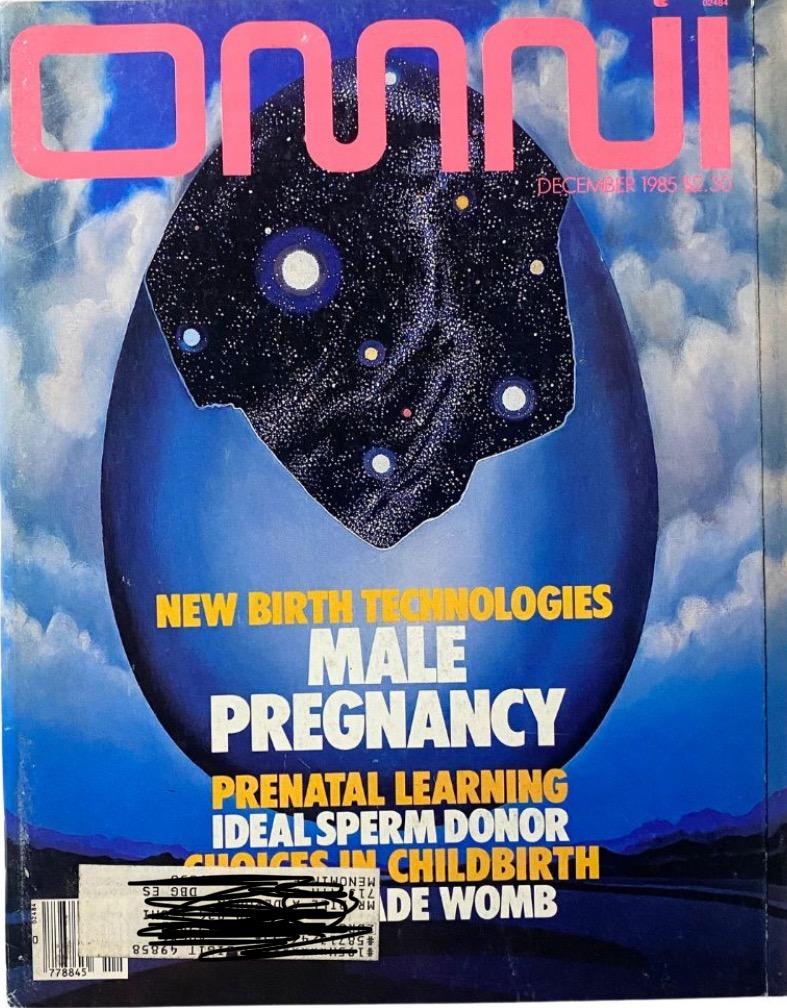 Omni Magazine cover from 1985 on male pregnancy.
@admitsWrongIfProven@qoto.org oh poop!
we can bring back the semicolon! accuse LLMs of overusing them, say writing with a lot of semicolons is usually AI slop, then watch writers and editors race to deploy them to defend their honor.
@light @AnnaAnthro you get frisky you put a condom on even though there’s no evidence a pregnancy will result. ex ante it’s just a risk, a meaningful one. so you address it.
i want to start the rival "Party in the USA"
@eARCwelder for a while. but only for a transition period.