
Higher education would be better if the people who participate in it, both as students and as educators, were there, on the terms they are there, because they affirmatively choose it rather than in order to pursue instrumental derivative goals.
The humans are always stirring up trouble with one another for really dumb reasons.
@eyesquash the reason we want to take money out of the economy so the stae can spend money without inflation or requiring very high interest rates. taking the money of the rich out of the economy doesn’t do much about that ‘cuz they weren’t spending it anyway. (you’d have to take a whole whole lot away before it’d have any real effect through their investment choices. either the investments are small relative to their net worth, or they bring along banks and others to limit their risk.)
My low volume, confirmed-subscribers, single-click-to-unsubscribe newsletters are getting rejected by Apple (me.com / icloud.com / mac.com e-mail addresses).
554 5.7.1 [CS01] Message rejected due to local policy.
Please visit https://support.apple.com/en-us/HT204137.
Anyone have experience resolving this?
@Phil the places you’d cut are also the limbs.
[new draft post] The $200,000 standard deduction https://drafts.interfluidity.com/2026/05/03/the-$200000-standard-deduction/index.html
@Phil at the moment things are bad. but things have been better, and many things remain better in other places. the point of productive pessimism is to figure out what to do rather than concede nothing can be done to forestall bad outcomes.
@Phil I agree that human nature is corruptible! And institutions are of course made of human actors. But I am more optimistic than you are that the susceptibility to corruption inherent in human nature is somewhat malleable to institutions and so culture, so I think a mix of institutions that encourage and reward virtue, along with checks and balances that impose accountability, can enable effective coordinated action at scale with tolerable losses to corruption and malfeasance.
@Phil I guess I'd say to shape rather than limit. The higher the quality, the greater their scope and effect might virtuously be. Since no institutions are perfect, and large-scale formal institutions will always face information problems, there will always be need for some limits. But as we get better at shaping coordinating institutions (if more than as at the moment), we might accomplish much by doing more with them. (My perspective as a social democrat may differ from yours as a libertarian)
@Phil I guess I'd say in any collectivity, there are institutions. Often large-scale or formal institutions don't develop. But family is an institution, parenthood. Warlord and submission thereto are institutions. Large-scale, formal institutions are prerequisite to what we consider success in modernity, but they also have profoundly catastrophic failure modes, they're double-edged swords. The work is to both develop those and to ensure their quality. Otherwise, modernity and prosperity fail.
@Phil Sure. I prefer the word “institutional” to "cultural”, though, because "culture” often becomes a kind of a residual, an unclear blob of how some collectivity behaves or is conditioned. It can be used to explain almost everything but affect almost nothing. Institutions are malleable, subject to rational critique. Although it is true that institutions are downstream from culture, in social affairs the arrows go both ways, institutional reform can also reshape culture.
@Phil Almost everywhere, there is incredible intelligence at an individual level among the population. But in some polities, that contributes meaningfully to success (success at a social level is prerequisite, beyond a few outlier warlords, for success at an individual level), and in other polities it's basically wasted. It’s what happens at the social, the institutional, level I'd argue that is the core differentiator.
@Phil That, my friend, is your prerogative to judge. I am the person saying it, as a individual.
intelligence and rationality are much more social than they are individual characteristics.
I've a surprisingly elaborate infrastructure for static-site generation that AFAIK only I use. Trying to sell a friend on giving it a try, I've built a static-site-generator-generator for sites that will publish themselves on push via GitHub Pages. Can I sell you on giving it a try, friend? https://github.com/swaldman/ghpages-unstatic-template#readme
try not to bother the humans.
#JohnHussman suggests essentially an excess margins tax. https://www.hussmanfunds.com/comment/mc260426/
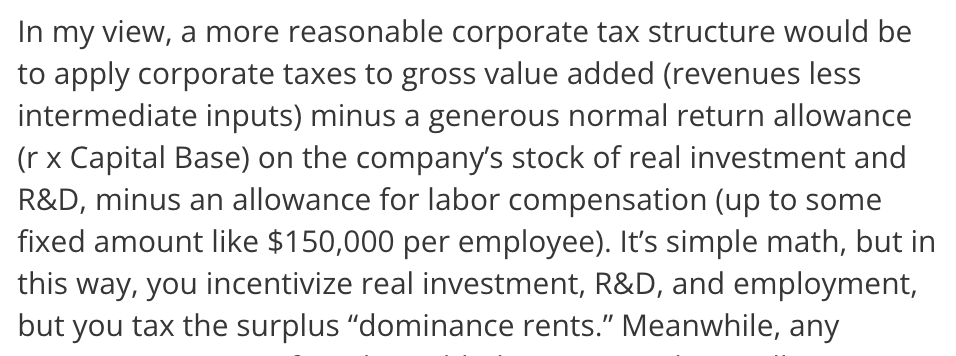 Text: In my view, a more reasonable corporate tax structure would be to apply corporate taxes to gross value added (revenues less intermediate inputs) minus a generous normal return allowance (r x Capital Base) on the company’s stock of real investment and R&D, minus an allowance for labor compensation (up to some fixed amount like $150,000 per employee). It’s simple math, but in this way, you incentivize real investment, R&D, and employment, but you tax the surplus “dominance rents.”
@Phil (my post was a critique of a certain kind of scientism, not of having children. my kid is — entirely unscientifically — the best!)
it would have been bad if either the Hatfields or the McCoys had nuclear bombs.
the costs of child-rearing are straighforwardly measurable and quantifiable. the benefits of child-rearing are wooly and hand-wavy and entirely nonquantifiable. therefore child-rearing is irrational, as a matter of science. your arguments to the contrary are non-falsifiable.