@djc but not "a safety net"! that is, the minimum is always there for everyone, not a thing you have to prove your misery in order to deserve.
(on the topside, i'd ask you to think about what it would take to solve the many social problems we face if we were serious and unified in addressing them, and why we don't do those things. we are paralyzed because a very few people are addicted to impossible lives and immersed in egotistic competitions.)
@curtosis your content warning is a thing of beauty.
fzf.
i've never heard of it, but it's so cool.
like so often i'm indebted to @llimllib https://notes.billmill.org/computer_usage/cli_tips_and_tools/fzf.html
@zhous98 i wish i had one!
@tofugolem@mastodon.social @kzimmermann let it be.
@enmodo one can be worse but still “ok”. saying “not ok” may just be not something people are eager to do. if you ask me how i am and i say “ok”, that often means pretty bad but i don’t want to whine to you.
@enmodo That's the point people who share my electoral politics typically make. I think it's wrong. I think this is in fact a pretty rough economy for most people, and that affluent professional-class liberals are letting their own good fortune and a very selective reading of "data" and "evidence" write discontent off just as "foxwashing".
People whose electoral politics is the same as mine seem very excited to share Figure 7, but they seem less often to share Figure 5.
Both from the same source, the Fed's Report on the Economic Well-Being of U.S. Households in 2023 - May 2024 https://www.federalreserve.gov/publications/2024-economic-well-being-of-us-households-in-2023-overall-financial-well-being.htm
#economics #finance
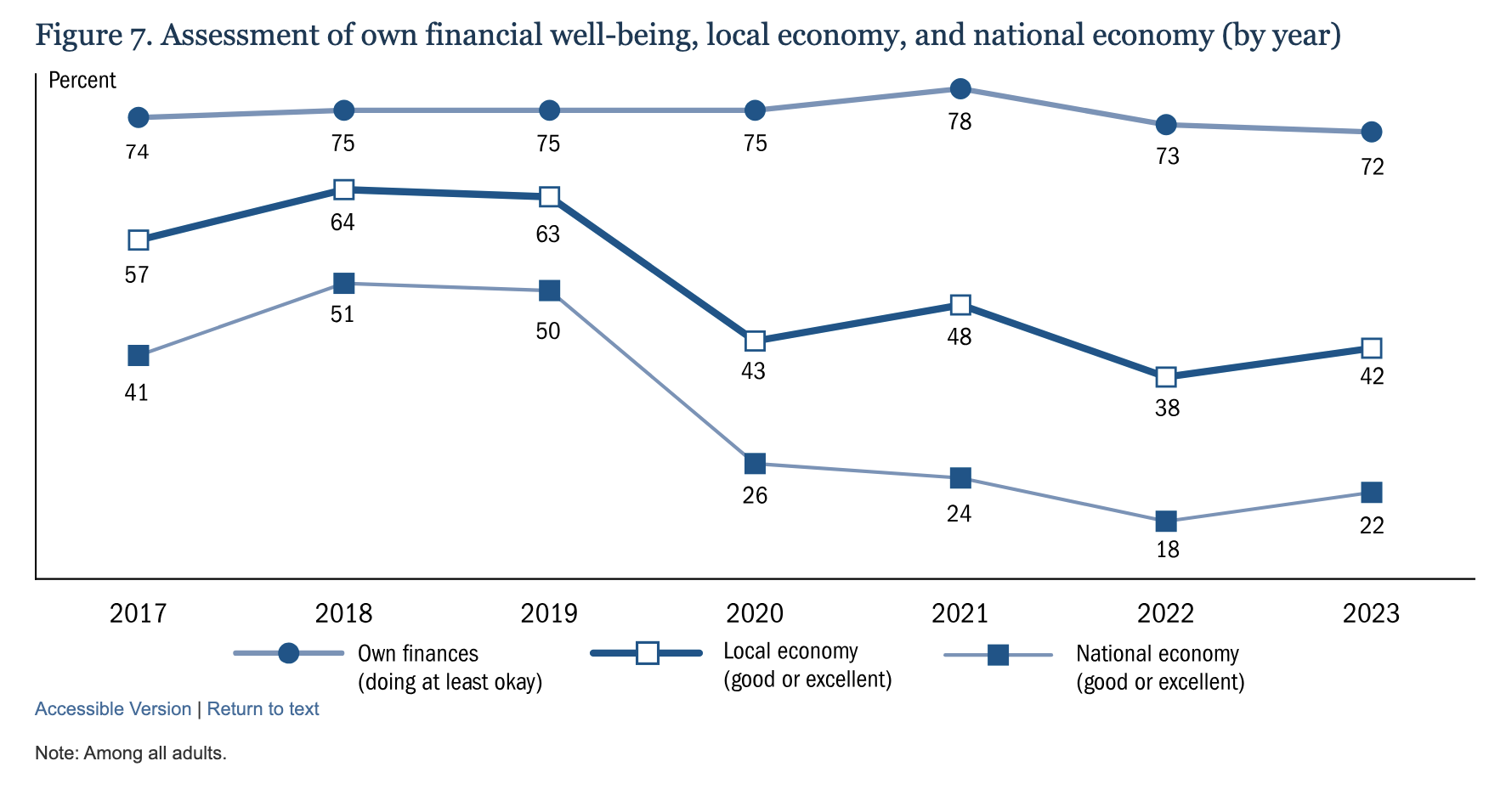 "Figure 7. Assessment of own financial well-being, local economy, and national economy (by year)" showing a steady 75%-ish describe themselves as "doing at least okay" financially, even while they perceive their local and the national economy declining.
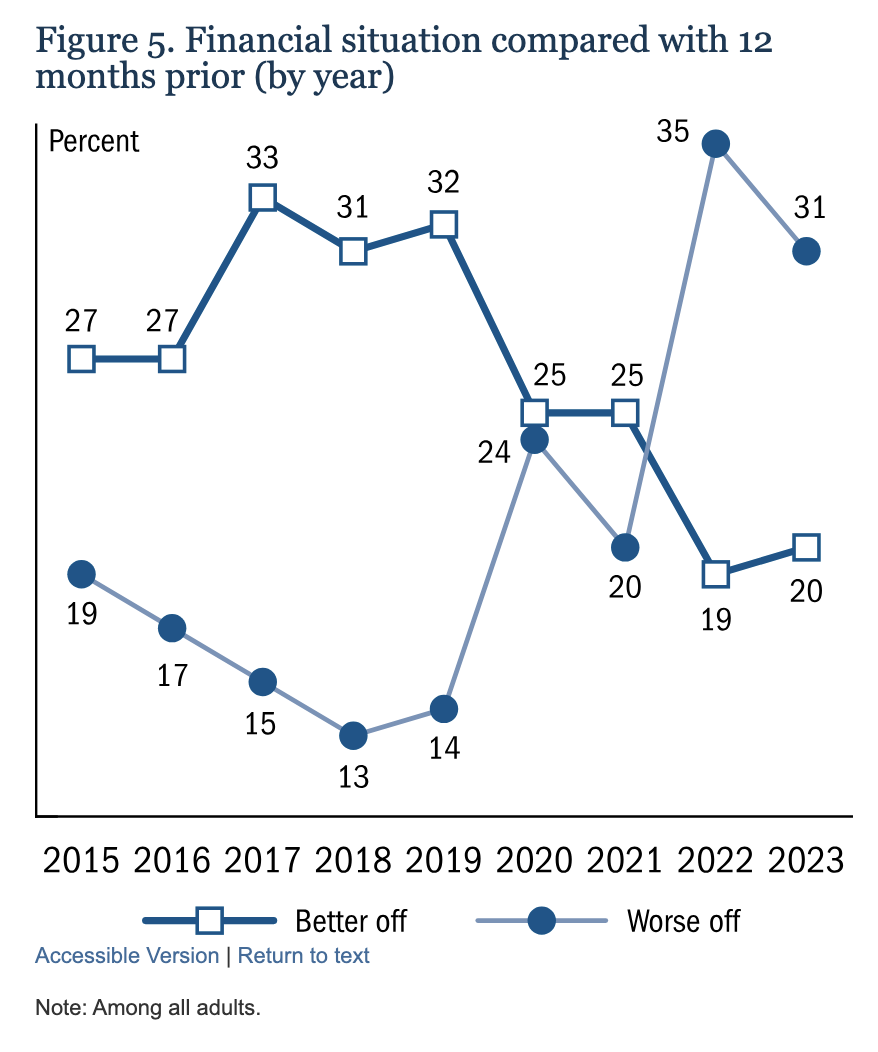 "Figure 5. Financial situation compared with 12 months prior (by year)" showing that of that "doing okay" in Figure 7, only about a third ever felt better off year-over-year, and since 2022, substantially more perceive themselves to be worse off than better off, year over year.
"Unless the government steps in to build when new home sales demand gets soft, we will not add homes to the builders’ demand algorithm. Builders have learned to tightly control inventory… We won’t see the construction boom that people want because the builders are here to make money; they’re not here to fix the low inventory issues of the existing home sales market, which is their main rival for demand." #LoganMohtashami https://www.housingwire.com/articles/why-we-cant-build-our-way-out-of-this-hot-housing-market/
#economics #finance
@scott the shards can be sharp.
@darwinwoodka perfection! so exciting.
sometimes the arc of history… just breaks.
katrina was a warning that we mistook for a fluke.
@LouisIngenthron i still look forward to getting (cheap) coffee sometime.
there's not a lot of money in not being evil.
@highvizghilliesuit and audioapps that show visualizations of waveforms will become taboo.
Overall, the United States __________ to COVID between March 2020 and July 2021.
2.1%
overreacted
(1 votes)
80.9%
underreacted
(38 votes)
17.0%
responded about right
(8 votes)
CONFIRMED: The falsehood is true.