
“In most companies, alignment is just the corporate name for silencing dissent. It doesn't mean everyone agrees. It means nobody says out loud that they don't. Those are different things.” https://phpc.social/@flowcontrol/116611921964285062
Ovid in exile.
 A nighttime photo of the statue of Ovid in Piața Ovidiu, Constanța, Romania, May 2026. The Grand Mosque and submarine steampunk bar Hypso25 are lit up in the background.
A person gets cancer. There is a therapy that has a good shot at keeping her alive, but it’s expensive. After fighting with insurance, she does get the therapy, but months have passed. The cancer has advanced and it’s too late. She dies. 1/
She might still have died had she received the therapy promptly. Or not. No one knows, but her odds would objectively have been much better. 2/
In medical consumption terms, she’s profoundly richer than a doppelgänger in her situation 20 years ago. The therapy didn’t exist then, no amount of money could have bought it. Present-day she did eventually consume a profoundly expensive good, which sold for hundreds of thousands of dollars. 3/
But in welfare terms, was she better or worse off than her 20-years ago-prior doppelgänger? 4/
Ex post, no, she struggled more and still died. But even ex ante. She had some probability of being saved that her predecessor would not have had. But the ex ante probability of failing to receive the treatment, or of receiving it only with ruinous delay, would be high for many patients like her. 5/
Ex ante, the expected expenditure, and therefore her expected consumption level, would be much higher, but it’s not at all clear that her expected welfare is improved given high probability, welfare negative outcomes. 6/
When systems are misarranged, people can both be wealthier in real terms in the ways that we would measure that, and also worse off in welfare terms despite all that. /fin
education is not preparation for the rest of life. the rest of life is preparation for education.
crypto was going to be something different.
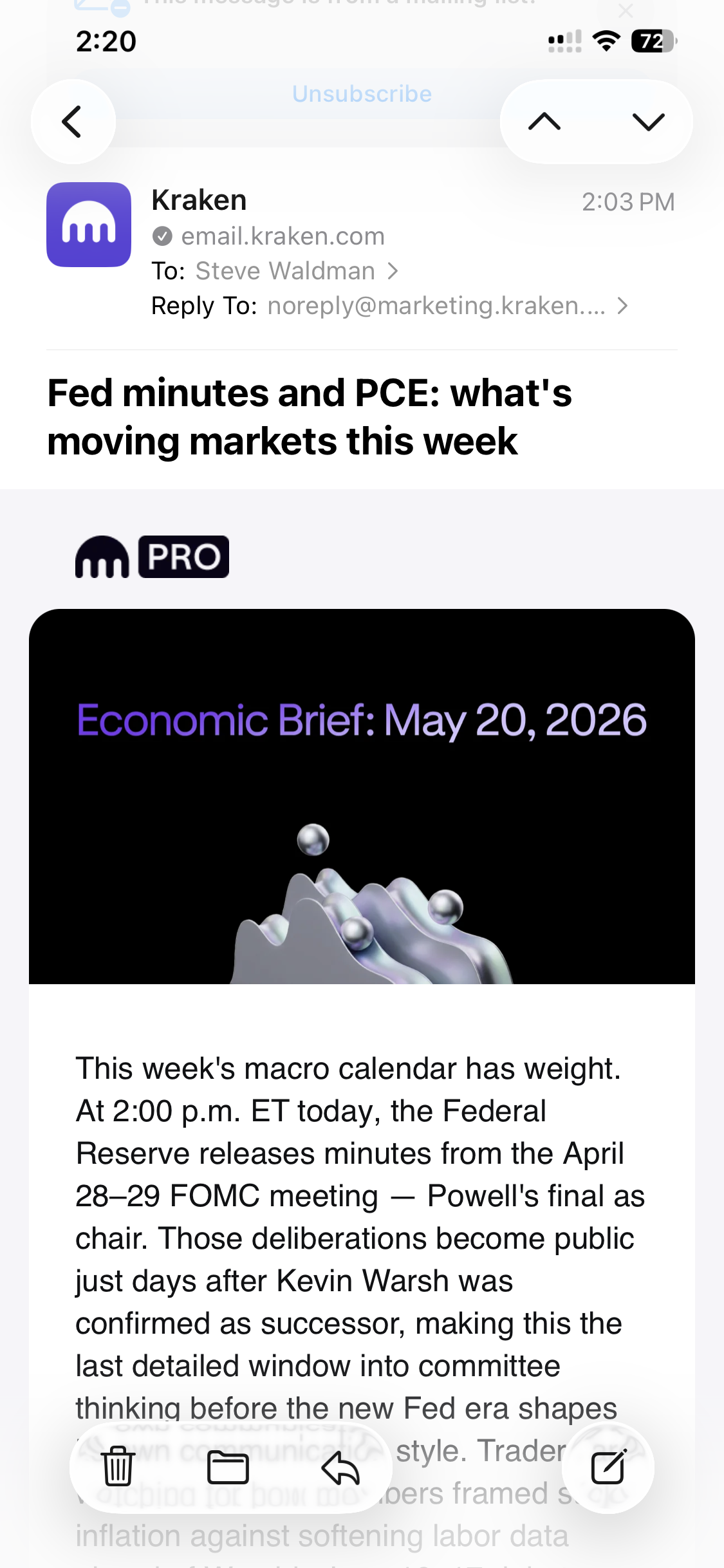 A screenshot of an e-mail: Kraken, a crypto exchange, sends out a very stereotyped, conventional “economic brief” about Fed minutes.
once every future becomes a retrofuture you have a problem.
so, it’s pretty much all term premium, right? or are people anticipating some really intense short rates a couple of years from now? #finance
@light Power of the logarithm. Let party hierarchies be three levels deep, less that a thousand in each local chapter, at a middle level, and at a leadership level. That's enough to accommodate the full population of the US. 1/
@light Alternatively you can go for quasi-online-direct democracy *among elected professionals*, but not the general public (whose members are rationally too busy doing other things to become specialists in deliberation and governance). That's the essence of this proposal: https://www.interfluidity.com/v2/9069.html /fin
@light Most people join… something. Maybe a political party, maybe some other thing. The people there know one another, know their shared values and interests. They choose people to act politically on their behalf, stay in continuous contact with those people, engage in politics primarily through them (or occasionally by replacing them), not by interacting with media and anonymously voting or writing congresspeople or whatever. 1/
@light Those people are professionals, like lawyers. Their job isn’t to dress like or talk like the people they represent. It is to continuously communicate and serve as a bridge between the institutions of political negotiation and contestation (e.g. Congress) and the group they represent, understanding their actual values and interests and competently pursuing those, discussing what is happening, what is practical or not and why, taking suggestions from those they represent. 2/
@light People engage in politics primarily via and through people they personally know and interact with. /fin
@light You are right, by the way, that I favor the role of experts to be “how”, and the role of the democratic public to be “what”. But right now, the democratic public can’t even coherently express what it wants, even were experts to be punctilious about not arrogating choices, maximizing rather than overriding the scope of the democratic public.
@light I don’t think it works. If you don’t have democracy, you have some form of tyranny. It can be benevolent and effective for a while, but at sine point the rulers lose touch with the ruled. Eventually terrible consequences (crushing oppression, bloody revolution) result. Experts are made stupid by their pride in their purported expertise. The way out of this is institutions. The details of how we rule ourselves matter much more than broad-brush labels I think.
if democracy is conceived of as rule by an atomized public informed by engagement-focused media, it will be a form of misrule. you can’t exhort media to be different to fix it. you have to reconfigure the polity to be something more rational than an atomized, distractable mass public. 1/
specifically, the democratic public has to rule by participating in institutions that both meaningfully enfranchise them and act rationally, rather than reactively, on behalf of their interests and values. 2/
usually when democracy has worked, these institutions have taken the form of political parties. but there are other possibilities. /fin
“Friendship…has always depended on a certain irrational generosity. A willingness to waste time together magnificently.”
Pranav Jain on “The quiet grief of adult friendship” https://timesofindia.indiatimes.com/blogs/civil-irony/the-quiet-grief-of-adult-friendship/
@elbowspeak i think it's a beautiful proposal. i am more than a bit despondent about this stuff. you emphasize pluralism, breaking the monopoly of an authority structure people like me now want nothing whatsoever to do with, and i certainly applaud that. i share your admiration for some alternative traditions. 1/
@elbowspeak but i don't think pluralism is answer enough to our divisions at this point, every pluralism requires a metaconsensus and i think that would be hard at this point. the things we have to agree to disagree about are very high stakes and very fraught. 2/
@elbowspeak further, i think the decades long monopoly you describe has polarized us, with it or excluding oneself from it, and most of us who have excluded ourselves from it have grown so distant that it would take a lot of work, and therefore a powerful reason, to try to reconstruct meaningfully jewish or yiddishkeit cultural life as part of a broader universalism. 3/
@elbowspeak every humane universalism is made of rich subcultures, but boy have the traditions attached to judaism been sullied now by history and current affairs. at this point it's not a matter of resurrection of anything, but of reappropriation, which when oppositional to the existing monopoly of authority sounds great, but then the same symbols we are reappropriating now have very difficult freight with other communities. 4/
@elbowspeak pure epithets — "queer", even "deplorable" — ironically were easier to targets for reappropriation. it'd be like progressive descendants of confederates trying to reappropriate the good parts of what was gone with the wind. it's not that those good parts weren't there, nor that contemporary descendants might not intend something genuinely new, ethical, open to embracing those they once excluded or worse. but traditions they mean to reappropriate have meanings to other communities. 5/
@elbowspeak i applaud you for writing despite all this, none of which i'm sure is new to you. optimism of the will despite pessimism of the intellect is the heart of much practical good in the world. i wish your enterprise well, and if there is any way i can help i would love to. 6/
@elbowspeak maybe if there is something practical i can offer it would be to begin with that radical openness, bring the people historically and currently excluded or worse by the current institutional formation into the project from the start (which implies usefully traducing some boundaries we take for granted about what defines who "we" are). /fin
can't imagine why the period from 2019 to 2022 might have left people who had hoped to buy a home a bit bitter. (and then, of course, there is the effect of rising interest rates on mortgage costs, ht @SteveRoth)
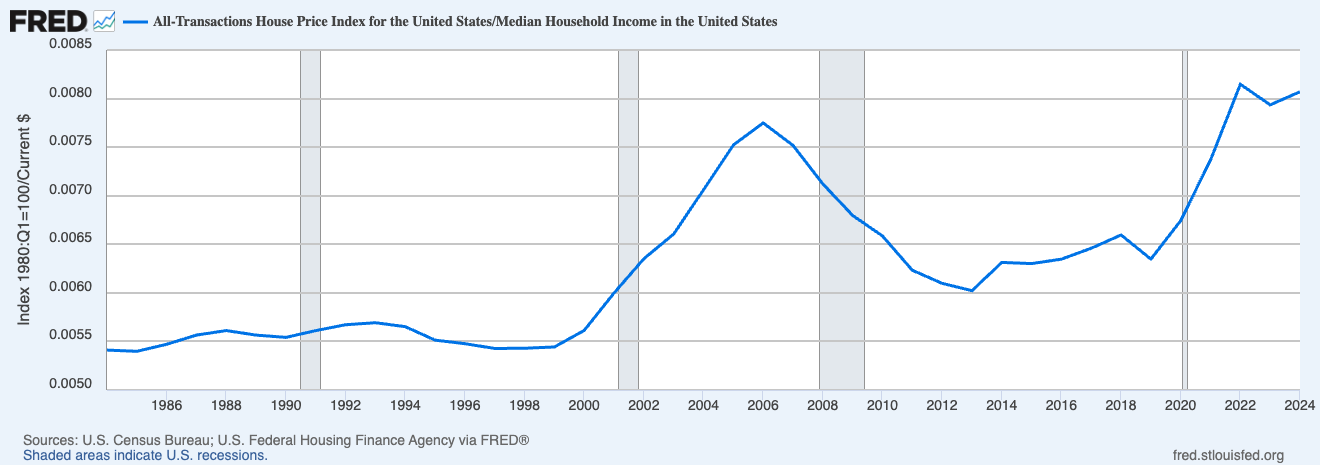 A graph of all-transaction-home-prices-for-the-US divided median-household-income-in-the-US, showing a sharp rise from 2019 to 2022.
@elbowspeak glad to discuss!
@elbowspeak I have! Come visit!
AM radio, 2026.
 A radio app on a dashboard touchscreen, set to AM 930 KHz.
@ouguoc (thanks! i don’t know anything about differences in the strictness of fiduciary duty between Canada and the US, but now i am interested.)
which disappeared first, local journalism or the local itself?
hard power only works as a backstop to soft power.