
@SteveRoth are 401ks / iras treated as pensions or just assets held by households?
@SteveRoth if wr could break out the equities portion of defined benefits pensions, then i’d think it should be included. i don’t think it’s likely to change the picture that much, but if it can be it should be included.
@SteveRoth using equity as “liabilities” at market value is a pretty good approach! although it brings in the issue of foreign holdings.
@SteveRoth it’s a question of the price of what we get. consumption is what we get. balance sheet equities represent the price we attach to the things that deliver it. i’m not trying to suggest consumption spending alone causes equity value (although indirectly sure), i’m pointing out that for the same consumption, the price of equity (that must be supported by cashflows!) is much higher than before.
@SteveRoth i prefer consumption, because consumption is the base, investment spending is derivative, it happens to support consumption.
substack converted some people who used to be interesting writers into car dealerships.
social media has made us hate social media at the same time as it’s given us sufficient perspective to be really, really aware of the shortcomings of traditional media.
@tarheel What this is saying — roughly, there are potential quirks to look at like share of consumption due to imports (would make things look worse as that's increased), share of equity value attributed to overseas sales (would make things look better, as that too has increased), share of businesses financed via equity rather than debt (i don’t know where this would land) — but roughly what this is saying is we know value the business that provide our consumption at 5 times what we used 2/
@tarheel to, relative to what those firms produce. That suggests we value equities at much higher prices than we used to, relative to what the firms who issue those equities produce. Which might be due to much higher profit margins (they are much higher!), which is good or bad news depending on whether your household holds a lot of equity or not. It's a distributional question. 3/
@tarheel It also might suggest financial fragility, that the prices at which we value equities relative to the value of what the firms produce are unusually high, and could mean revert (either because profit margins revert, get competed down to traditional norms, or because "multiples”, how much investors pay for each dollar of profits or dividends or other payouts returns to smaller, more historically normal values). 4/
@tarheel Of course nothing says profit margins and valuation multiples *have to* revert. We could, to coin a phrase (it's really Irving Fischer’s phrase) have just reached a “permanently high plateau”. It's fair to say I am skeptical. /fin
@tarheel Households don’t hold "more”. They always, in aggregate, effectively hold ownership of the businesses that serve the economy. What this ratio is telling you is the *price* at which they are valuing those businesses. If we used raw numbers, all kind of inflations would make comparisons very difficult. But if we describe that price as a share or multiple of the total amount households spend on consumption — from which business values derive — we try to get apples to apples. 1/
“Even if the AI companies themselves are not particularly (or at all) profitable, AI-related investment spending is probably an important factor in raising aggregate profits. Just like the California gold rush generated plenty of profits for somebody, even if the vast majority of prospectors themselves went broke.” @jwmason https://jwmason.substack.com/p/profits-payouts-and-equity-prices
@dpp yes. the bad bank now would be the US dollar system, rather than just the private financial system.
one way to understand contemporary politics is we are collectively playing an ultimatum game, capital has made its proposal and this is what it looks like when the rest of society struggles to say no.
@Phil@freeatlantis.com i hope it doesn’t go beyond that.
@Phil@freeatlantis.com we all mostly live or die on accidents. i'm glad you tripped into a good spot.
@Phil@freeatlantis.com yes. though in theory it is possible to stabilize an economy through a financial crisis, and it has arguably happened occasionally (remember the 1987 stock market crash?), usually financial crises do result in economic crises.
@Phil@freeatlantis.com if AI puts everyone out of a job, that's an economic crisis. if it puts everyone out of a job by doing the work just as well but more cheaply, the state can address that by redistribution, sending cash flows back to the people who lost jobs, and the extra purchasing power for the more cheaply could be devoted to care work, yoga classes, whatever things humans still prefer humans for, reemploying many. 1/
@Phil@freeatlantis.com a financial crisis is not the same thing as an economic crisis. there are many economic crises that don’t provoke financial crises, and there can at least in theory be financial crises without serious economic crises (though in practice that is rare). 2/
@Phil@freeatlantis.com the financial crisis we are on the verge of has simply to do with the huge share of wealth and income embedded in financial assets and returns, wealth levels sustained by prices only justifiable if those returns continue indefinitely at rates much faster than the growth of the economy as a whole. a financial crisis is ultimately a form of social conflict. 3/
@Phil@freeatlantis.com financial assetholders come to "bank on” the value of their financial assets, which they understand in theory are at risk of losing value, but which in practice they've made plans against they'd not be willing to concede with assertive political intervention to prevent or undo the losses. 4/
@Phil@freeatlantis.com but the cash flows that support financial asset values must come from others. your income, even if it takes the form of dividends or interest or capital gains, is ultimately someone else's expense. 5/
@Phil@freeatlantis.com assetholders grow rich, and intervene ever more aggressively in politics to ensure there are flows to validate asset prices and the wealth they have come to rely upon. those who hold relatively small asset nest eggs are net payers, and eventually object or refuse or just throw over the table in some form or other. ultimate outcomes are not very predictable, especially over longer timeframes. our politics remain mostly just aftermath of the great financial crisis now. 6/
@Phil@freeatlantis.com a financial crisis under current conditions might be much more disruptive, because it is foreign enthusiasm for US financial assets that currently sustains the value of the US dollar. that was not really the case in 2008, when official reserve flows (e.g. from China) supported the dollar. treasuries and the dollar were a “safe haven" post-2008, empowering the US government to cut checks to bail out influential parties, and have those checks be valuable and effective. 7/
@Phil@freeatlantis.com in a financial crisis under current conditions, that might not be the case. /fin
the thing about the past is though it was not then, it is now, a safe place.
@tarheel so, to a first approximation, households are the "roots" of the economy. firms may hold shares of other firms, but those firms are ultimately held by households, so indirectly the households hold approximately all the firms. there is still that "approximately" there, because the state owns things, and in the accounting households are not taken as indirectly owning the state. and the foreign sector can hold equities as well, not just domestic households.
in orthodox economics, the value of firms is entirely derivative of the value of consumption by final purchasers. providers of intermediate "capital" goods are valuable because they contribute to production of consumables. with that in mind…. https://fred.stlouisfed.org/graph/?g=1X3BM
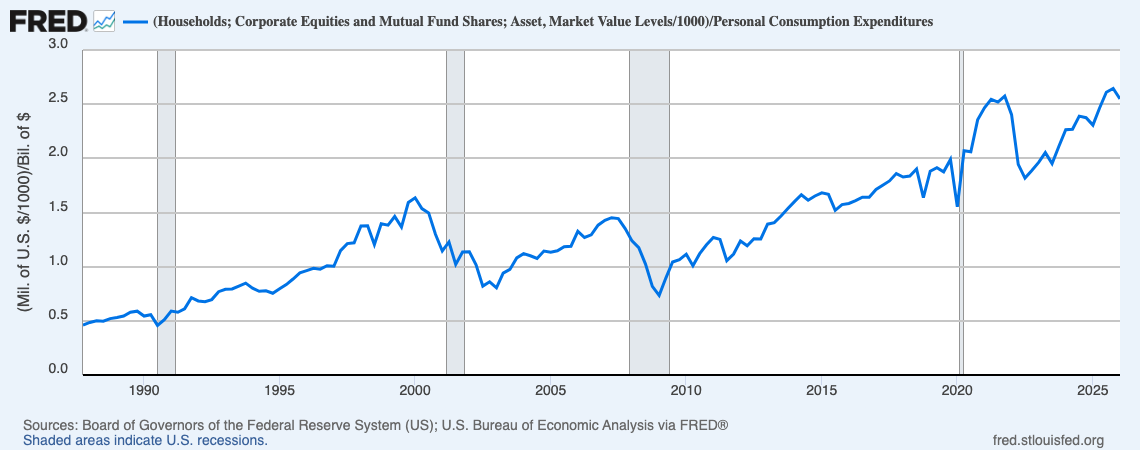 A graph of the value of equities and mutual funds that households hold — basically equities directly or indirectly — as a share or multiple of personal consumption expenditure, from which their value ultimately derives. equity values were half of PCE in the 1980s, more than 2.5 times PCE now.
two things can simultaneously be true: (1) contemporary AI is real and revolutionary technology; and (2) we are courting the greatest financial crisis in the history of humankind.
@polarizing_is_bad our job to make sure there is.