
@SteveRoth while we're being persnickety, it's not SWF vs no SWF, but the activity. an SWF is just a formalism within the state. invested funds (there's another word to unpack!) are likely to be less inflationary (with nothing special about the zero-point, so sometimes disinflationary) than simple transfers. (although sometimes transfers might count as investments! in which case they might be disinflationary!) whether the formalism of an SWF (or central bank) are involved is not really material.
@SteveRoth debts/deficits and inflation can both have similar causes, there can be correlations, but they are far too loose to treat debt as predictive or a measure of inflation risk.
debt backed by productive assets is *disinflationary*. debt engendered by effective transfers to the very wealthy is close to noninflationary. debt as an accounting quantity is a very bad measure or target. we’re not interested in the accounting quantity per se, and it doesn’t predict what we *are* interested in.
@SteveRoth “do the SWF-style JCB non-gov equity/bond asset holdings protect Japan from that inflation? If so, how?”
debt backed by (sufficiently) productive assets is disinflationary. 1/
@SteveRoth if the state goes into debt to build infrastructure that reduces production and distribution costs, whatever extra aggregate demand comes from the deficit spending (hard to predict, depends on distribution, regulation, interest rates) can be more than matched by the infrastructure’s contribution to (downward shift of aggregate supply curve). 2/
@SteveRoth if the state goes into debt to buy domestic financial assets that appreciate and/or yield, income flows (broadly construed!) that would otherwise contribute to aggregate demand of the private sector instead accrue to the state, offsetting any contribution to aggregate demand of the initial purchases. 3/
@SteveRoth if the state goes into debt to purchase foreign financial assets, and those appreciate in domestic currency terms or yield FX income flows, the states capacity and likely actual practice to support the value of its own paper by selling FX or foreign assets and purchasing domestic paper increase, disinflationary as an ordinary practice in ordinary times (although sometimes “blood in the water” if initiated during a currency/inflation crisis!) 4/
@SteveRoth it’s just not a good frame, to say debt is inflationary but a SWF is protective. it’s more accurate to say going into debt to build an SWF is disinflationary if the investments are “good” (lots to unpack there!), inflationary if the investments are not. the debt per se can’t be evaluated in its inflationariness independent of what’s going on on the asset side, what it is funding. /fin
it’s kind of weird that “ghosting” means the opposite of “haunting”.
not very hopeful. tremors in a once-and-hopefully-not-future catastrophe that haunts present day catastrophes. https://www.theguardian.com/law/2023/nov/23/former-yugoslavia-countries-war-crimes-past-risk-return-conflict-council-of-europe-official-says
what AI may teach us is
how desolate is
a machine without a ghost.
"Capitalism is itself a kind of artificial intelligence, and it’s far further along than anything the computer scientists have yet coded." #EzraKlein https://www.nytimes.com/2023/11/22/opinion/openai-sam-altman.html ht @MattHodges @tchambers
// we've been in the foom for quite a while, no need for transformers or LLMs to get us there. though they'll add spice.
i'm less interested in #StuartSeldowitz than i am in the question of how a person with his views and mien attained the positions he attained, whether the systems that enabled that have been reformed, whether there aren't likeminded colleagues who continue to, um, serve.
@bhawthorne@infosec.exchange @april you live in a better timeline, at least from the perspective of those of us fond of our mythical Australias.
@dpp @SteveRoth certainly informed by what i think is helpful from the MMT tradition!
@failedLyndonLaRouchite @SteveRoth a lot. if anything it’s more accurate to say private banks are “mini-me”s of currency issuing states. as financial entities, their similarities are more than just analogy.
@SteveRoth I don’t think we should start from a presumption that a large prosperous economy with “debt” in an accounting sense of 226% is a puzzle to be resolved. the ability to issue securities accounted as debt (including currency and own-currency binds) in high amounts reflects “large, prosperous” rather than contradicts it. If that debt were in FX it’d be more challenging. 1/
@SteveRoth Among other things, a fiat-issuing govt can be understood to be a bank. It issues deposits and banknotes to spend money and purchases assets, just like any other bank. Unlike other banks, it need never default outright on (own currency) claims, but “fails” via inflation, devaluation of its notes and deposits. Also unlike other banks, it can issue taxes to try to prevent or diminish or recover from any such devaluation, but is subject to real and political constraints in doing so. 2/
@SteveRoth The analogy to a bank is not so useful for a government that issues notes and deposits (and bills and bonds, “savings accounts”) almost solely to purchase current goods and services. Banks do that too! When your bank buys a pencil, it issues deposits to an office supply store. But a bank that primarily does that just expands its debt without creating offsetting assets or sources of revenue, and would be expected to fail. 3/
@SteveRoth A government that primarily buys current goods and services can make use of taxation to mitigate (not necessarily arrest) the expansion of debt, and can use regulatory tools to help prevent “failure” (inflation beyond expectations it has telegraphed to its public). This is how we ordinarily think of governments, as not-banks-at-all, but tax-financed purchasers of current public goods. Let’s use the catchy acronym TFPCPG for this kind of government. 4/
@SteveRoth Except these are not distinct “kinds” of government at all! Bank and TFPCPG are roles that every fiat-issuing government takes on to varying degrees. To put it more sexily, every fiat-issuing government is a superposition of bank and TFPCPG, in varying degrees. 5/
@SteveRoth What might predict these degrees? All govts have obligations to our purchase large quantities of current public goods. For the purpose of this analysis, we’ll pretend those obligations are constant across governments, although of course they are not, quite. That’s a wrinkle for later. Then what predicts the degree that states use taxes+regulatory tools to support the value of the securities they issue vs generating claims whose value exceeds the cost of debt issuance, like a bank? 6/
@SteveRoth Holding constant (again, inaccurately, but for now) current public goods obligations, we’d compare the costs and benefits of the two “business models” that support the paper: banking and tax/reg. 7/
@SteveRoth Let’s again, not quite accurately, assume that the costs and benefits of using taxes and regulation to support a currency are the same across countries. Then all that’s left is the relative opportunity to a state of adopting the banking business model. 8/
@SteveRoth What determines how good a business banking is likely to be? Three things: (1) deposit rates you’ll have to pay; (2) returns from assets you’ll puchase with the borrowed funds; and (3) the amount of leverage you can take on consistent with (1), any regulatory constraints, and your own risk tolerance. If you can earn a big spread (deposit rates are low, asset returns high) and lever way up, you can make a lot of money in banking! 9/
@SteveRoth All three of these factors are conditioned by risk however. If depositors perceive your securities to be risky, then (1) will be high, limiting your spread. If you (the banker) perceive your own risk of failure to be serious, then (2) and (3) will be blunted, as you will buy more conservative, lower-returning assets, and lever them up less. 10/
@SteveRoth So, finally, Japan.
The risk, from both depositors’ perspective and the state’s is higher inflation. That’s the failure mode of states-as-banks.
But, for Japan, that’s a bit of a briar-patch risk, as they spent decades grappling with deflationary currents. Their loose fiscal is largely a result of this experience, and is presumably to some degree at least reversible, creating a second firewall against unwanted high inflation. 11/
@SteveRoth As both citizens and state agree that the risk of “failure” of state-as-bank is low, citizens demand low rates on deposits, state can purchase risky, high-return assets at a high degree of leverage, rendering the banking business model, at least in ex ante expectation, extremely lucrative. 12/
@SteveRoth So the Japanese state, like all fiat-issuing states, is a superposition of bank and TFPCPG, relies on both models. But, by virtue of its own circumstances and history, the banking model is especially attractive and the state perceives itself as capable of taking unusually aggressive risks for a state, in terms of both the assets purchased and the degree of leverage. 13/
@SteveRoth The result is, well, Japan. 14/
@SteveRoth The talk of “financial repression” or depositors under-remunerated for risk is just a kind of bullshit a certain kind of economist uses to condemn states where the same economist would laud businesses. All banks take a surplus by virtue of “under-remuneration of depositors” like all standard businesses take “surplus value” from their workers in a Marxist telling of the tale. 15/
@SteveRoth These economists condemn neither private businesses nor private banks for not paying through to factor providers the full product of the factors provided, but instead extract a surplus. But when the state does the same, on purely voluntary terms like any private business (no one forces citizens to hold currency or deposits or bonds), it is “financial repression” or households are “uninformed”. 16/
@SteveRoth Only in the same sense we all are, when we as almost always we fail to force business’ economic profits down to zero as in some perfectly competitive hypothetical. 17/
@SteveRoth Here the state is using its pricing power as monopoly provider of currency and credit-risk-free debt to substitute for relying much more on taxation. We can argue about whether that’s wise, whether as a social matter the flows and incentives this form of finance engender are better or worse than some tax counterfactual. 18/
@SteveRoth We can argue about whether from a democratic perspective the covertness of this form of finance (though no more covert than all business profit) renders it worse in some ethical or political sense than taxation. 19/
@SteveRoth But calling it “financial repression”, or using the zero-profit deposit rate as the baseline below which we claim depositors (currency, bank deposit, govt debt holders) are under-remunerated is just to smuggle in ideological assumptions to prejudge these questions, rather than to ask them. /fin
@april verified!
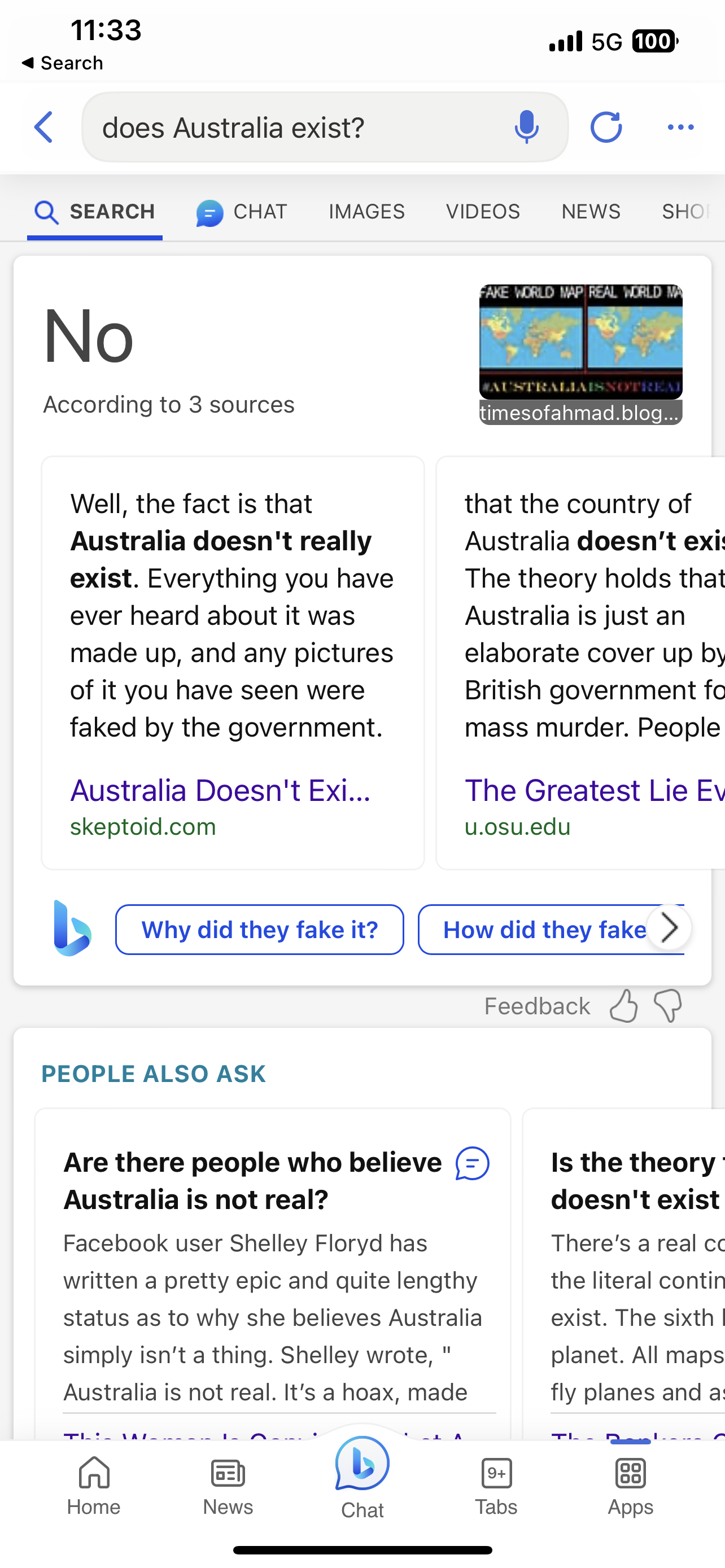 Screenshot of mobile Bing search saying “No”, Australia does not exist.
@april does hope exist? “…Hope is not lost as long as you are alive and willing to respond to God's call.”
 screenshot of Bing responding to “does hope exist?” with a rather religiously inflected yes. Text: The user query is a vague and personal question that may not have a definitive answer. However, based on the web results, one possible summary is:There is still hope for you and the world. Despite the challenges and difficulties that you may face, you can find support and solutions from God and from others. There are also innovative ideas and actions that can help repair the damage done to the planet and create a better future. Hope is not lost as long as you are alive and willing to respond to God's call.
@djc tells you something about the parties to the conflict, then.
@w7voa Thank you!
Larry Summers on the new board?
Why?
https://www.theverge.com/2023/11/22/23967223/sam-altman-returns-ceo-open-ai
ht @Drwave
you'd think CGI would have made the shitshow an actual genre, like claymation.
For most people, the wind-down of the COVID welfare state has hurt more than the genuinely good employment economy and increasing real wage incomes have helped. Improved household balance sheets are mostly in rising home and used car values, wealth nonrich families can't actually tap, since they need their one home and one-to-two cars.
See #MattBruenig https://www.peoplespolicyproject.org/2023/11/20/how-has-wealth-changed-under-biden/
lobster bisquick would be a brunch food.
@gideonro @bmacDonald94 “rather than feeding the frenzy of the speculative casino that we call modern finance.”
so far this is a road crypto broadly has chosen not to walk. until token designers build systems that eschew fast price appreciation and untethered upside as sweeteners, crypto will remain not a friend of these kind of ecosystems.
(i devoted several years, lots of exhortations, to this stuff. i’m so disappointed.)
@nelson ready to learn!