
Subscribe to unlock.
the secret, said the dark occultist to his quavering apprentice, is this.
you just fake it ‘til you wake it.
@SteveRoth great point. yes. who knows how the hypothetical market dollar value of the uninhabited American West might have changed?
does the argot "jonesing" for something come from the expression "keeping up with the joneses"?
( dictionary.com attributes it to Mr. Jones as a slang term for heroin, which probably makes more sense. but now I have to reinterpret the song. https://www.dictionary.com/e/slang/jonesing/ )
Total real-estate at market value to GDP (excluding financial-sector business, which the Fed flow of funds does not track)
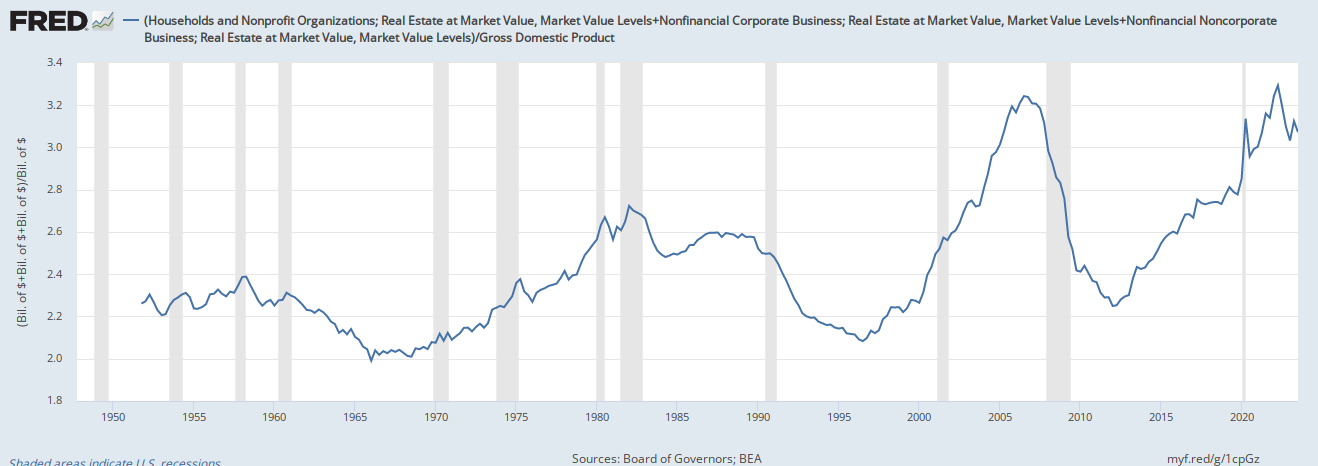
@SteveRoth i don't think you were a fake news purveyer! i'm just looking at graphs, thinking about 'em, trying to distinguish a bit between valuation and financialization as conceptually distinct phenomena.
@perfect_brains and these institutions (and the households that own their funds) end up owning claims on a greater share of the now-and-future economy then their forebears did in earlier eras did.
@SteveRoth (sounds like a mastodon.world issue!)
household corporate equities + mutual fund holdings at market value to gdp. a mix of both financialization effects and valuation changes. (imperfectly captures total market cap to gdp, as not all mutual funds are equities, and omits other mixed instruments like pension funds.)
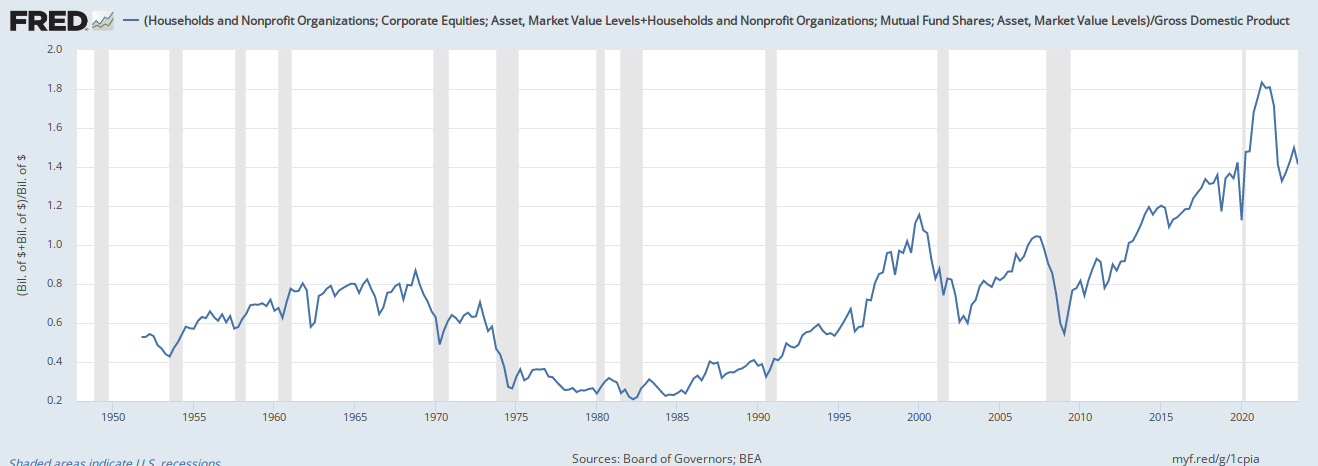 graph of ((Households and Nonprofit Organizations; Corporate Equities; Asset, Market Value Levels) + ())/GDP, a dirty measure of the market value of corporate equities to GDP. Also a nadir in the 1980s, rising now to levels much higher than post-war, pre-1980s norms.
@perfect_brains the owners, whoever they are. not wages, even the high wages of top managers, but assets (which of course top managers may buy with their wages!)
@perfect_brains the numerator of the chart is the sum of the market value of financial claims, which by definition represent claims on options to capture future output.
@failedLyndonLaRouchite that's always a good point. do things matter in levels or logs etc?
but this is just one quick correlate of a braod set of trends i think we understand to matter, we have lots of reasons to know that, since postwar mid-20th-C, outcome dispersion and various forms of social contestation are increasing at the same time as we've seen highly unequal capture of financial claims that grow faster than the economy, and they seem likely to be related.
@perfect_brains there is output from human production. some of that output disperses in the form of wages or transfers or whatever. other of that output is either captured by owners of financial claims, or else sold for continuing, often increasing claims. this shows the share of the latter growing with respect to the former, which is ultimately what financialization means. a greater share of social wealth broadly construed claimed by formal financial asset holders.
@failedLyndonLaRouchite somethig like that for the pandemic.
a 60% increase in the degree to which access to output is enclosed in the form of lopsidedly distributed claims on future streams of output is a very big deal, i'd argue. all else equal, in theory population aging should reduce these sorts of claims, as in theory older people decumulate. most older people have few financial assets and in practice those who do don't much decumulate, again putting inequality at the center of the story.
financialization.
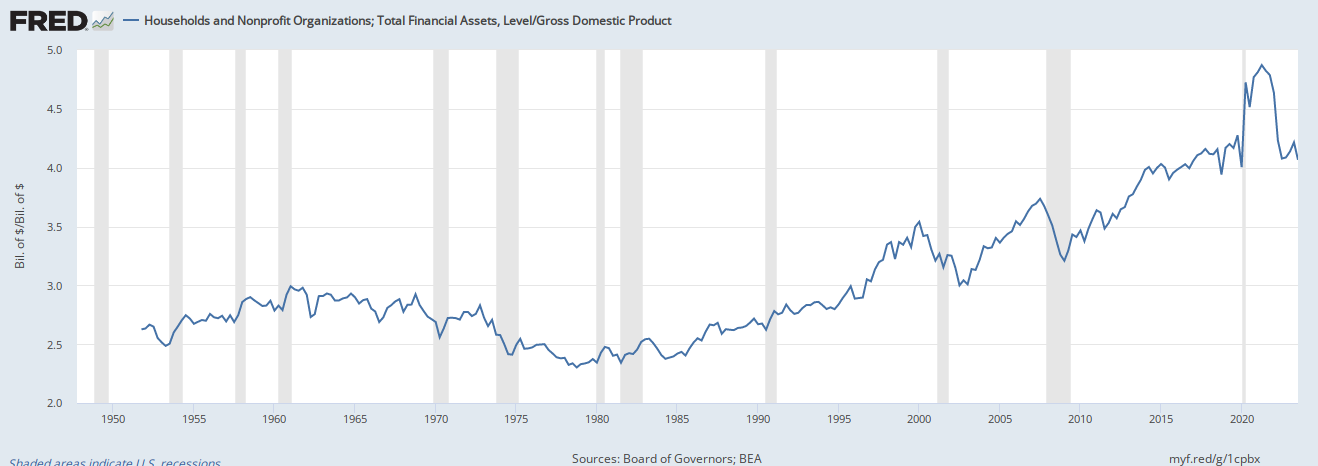 graph of total US household assets (from the Fed's Z.1 Flow of Funds) to GDP, rising steadily from a nadir in the 1980s through the 2010s, to levels well above prior norms.
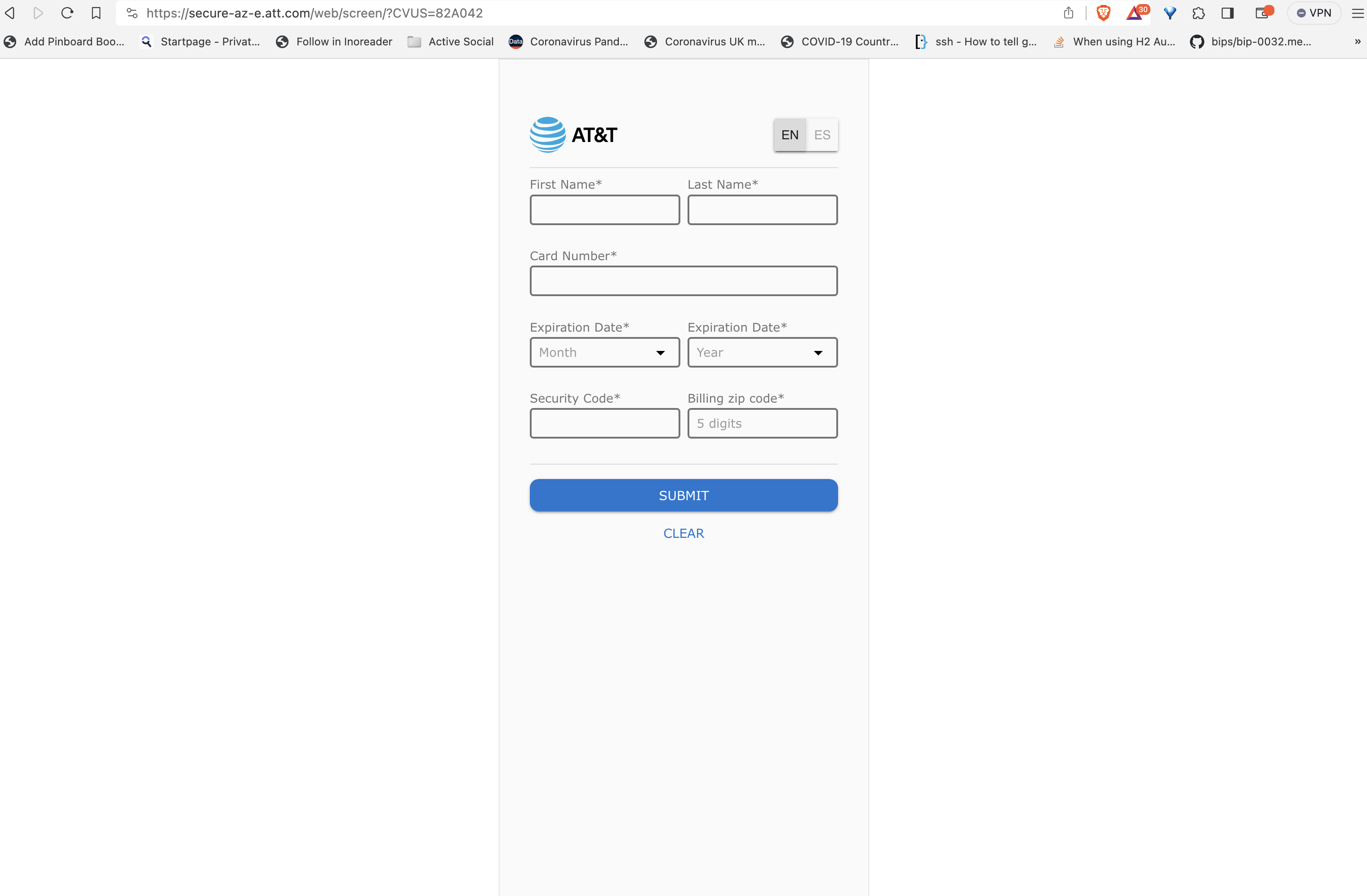
@StefanThinks especially the digits.
@djc is think they found an existing system they could trick to generate a credit-card entry form. the guy actually didn’t want me to enter the information there, he apologized for some mistake and said he had to generate a new link. (i didn’t stick around for that one.)
@admitsWrongIfProven@qoto.org perhaps similarly amoral money vacuums.
I played along on a pretty elaborate phone fraud by a person impersonating AT&T. They'd gained access to my account somehow, knew my billing history and info, promised a statement credit and were able to "issue" it—by posting a fraudulent payment from a random checking account. They caused a link to be generated, valid SSL from within att.com, asking for credit card info.
I stopped playing along when they solicited a credit card payment for shipping my, um, free iphones.
It's rough out there!