
enter, withdraw. enter, withdraw.
Paris Agreement is for lovers.
enter, withdraw. enter, withdraw.
Paris Agreement is for lovers.
a very possible future for US jews, i think.
rather than, or supplementing, rank old-school antisemitism…
“i think it may look more like, hey, of course we love you, but you were never more than visitors here. we just cleared out some nice beachfront real estate in your true homeland. don’t you think you wouldn’t be happier there? we’ll increasingly insist you would be happier there.”
( quoting myself, transplanted from a BlueSky conversation https://bsky.app/profile/interfluidity.com/post/3laolsgkiee24 )
“The Party Should Throw Them a Party” by @resnikoff https://resnikoff.beehiiv.com/p/the-party-should-throw-them-a-party
// excellent on the need for thick ties between real-life humans to build coalitions and realities resilient to a captured, fickle parasocial online
@ItsThatDeafGuy the advice stands.
when history is on the march, run.
This post is all I’ve done with my life.
way, way ahead of me is @ouguoc! https://mastodon.online/@ouguoc/109520757654139083
his growing scandal will become known as elongate.
@Canevecchio until around Y2K, i don’t think it was obvious that China was the essential rival or partner. but around Y2K, yeah. that’s when the US ought to have been doing some hard thinking about what kind of relationship it wanted to forge with an ascendant China. instead of hard thinking, we adopted a wooly market triumphalism that presumed commerce and development would automatically turn everybody into friends.
one path by which this event may mark the end of the American century is that whatever vestiges of a soft power / aspirational advantage the United States still had over China are lost.
if the indispensable nation is going to be a venal autocracy anyway, China may seem a lot more attractive than the United States. alliances and inclinations of the US’ erstwhile foreign partners may quickly reconfigure themselves to that.
@dedicto @MamasPinkyToe immoral purposes are now obligatory here. you can transport yourself across a border if you intend moral purposes.
@BenRossTransit The thing is, I don’t think he really presents as a strong man on “intimate” social media. I think he presents as a nice, reasonable guy who says some crazy things people who like him are willing to look past. And even if you don’t fully buy “Trump will fix it”, if you think he’s a fundamentally decent who exaggerates, you think “well, he’s going to do his best, he’a going to try”. 1/
@BenRossTransit it’s a bit like the “aim for the stars and you will never reach them, but you will go much higher than if you’d aimed for the tree” inspirationals. if what you see in Trump is a venal, self-interested con man, his grand claims just sound like deception. but if you think he’s a decent guy who overstates stuff but fundamentally means it, it signals ambition on your behalf. /fin
@BenRossTransit yeah. i think that’s right too. although i think by emphasizing “strong man” rather than “fix everything” we deny for ourselves an ethical path to compete. he said he would fix everything! he said things would be great, a new golden age. dems are too “reality based” to let themselves promise that anything will fundamentally change. it’s hard to get people excited over the slow boring of hard boards when the other guy is offering an amazing (if brave) new world.
@BenRossTransit i mostly think the campaign was lost not because of bad targeting or particular issues, but because the Trump campaign used new media to create a kind of tribe, in which belonging and (mostly false) worldview reinforced one another, in which the tools of a confidence man did their core work, engendering trust. https://drafts.interfluidity.com/2024/11/08/its-the-parasocials-stupid/index.html
“We're still the same country that we were on Monday. We just have changed our form of government.” #HeatherCoxRichardson https://youtu.be/D7cKOaBdFWo
i feel like some random kidney cell still kidneying in the body of a thing that just blew its own head off.
@scott the president does have much greater capacity to raise small dollar money to counter, even taking into account the vaster scale of the race, i think. campaign cash has diminishing returns. and of course “earned media” is free, and most important. Harris could have done a zillion podcasts, for free, and if she came off well they’d have been worth a lot more than her expensive ads.
@scott they raised a shitload of small donor funds. yes, without big donors, they’d need tighter budgets, and less lavishly paid consultants. would the loss of infinite money be made up by freedom to take more populist (and genuinely virtuous) positions?
there’s definitely a tradeoff to weigh. we don’t know counterfactuals, but we do no that twice this trade-off worked out poorly. but once, with Biden, it worked out well!
it’s not easy.
from #ThomasFrank https://www.nytimes.com/2024/11/09/opinion/democrats-trump-elites-centrism.html
(the piece is badly titled.)
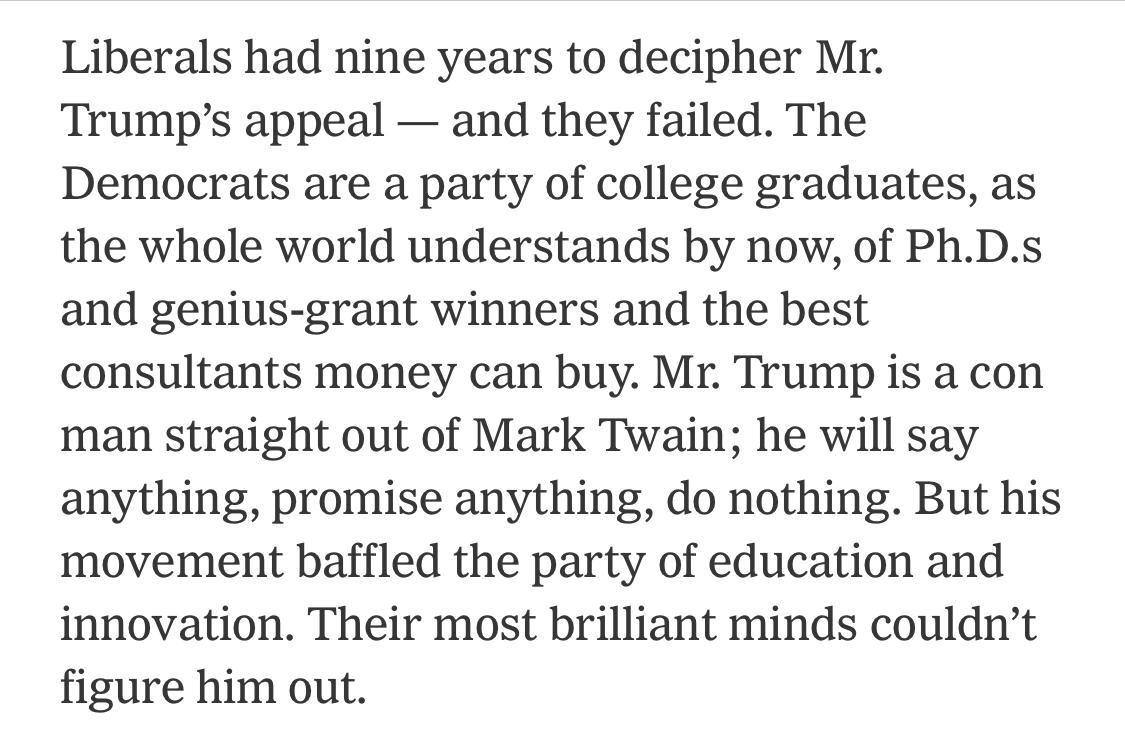 Text: Liberals had nine years to decipher Mr. Trump's appeal - and they failed. The Democrats are a party of college graduates, as the whole world understands by now, of Ph.D.s and genius-grant winners and the best consultants money can buy. Mr. Trump is a con man straight out of Mark Twain; he will say anything, promise anything, do nothing. But his movement baffled the party of education and innovation. Their most brilliant minds couldn't figure him out.